
A good puzzle asks the player to solve a problem, while making the available clues understandable. Before judging how an immersive scene presents those clues, establish a working viewing setup; Brain Dance VR offers a reference for the playback side. The puzzle’s own controls and accessibility options still need to be checked in its developer’s instructions.
Imagine a room containing three levers, a coloured panel and a locked door. The solution may be difficult even when every element is clearly visible. That can be an intentional challenge. It is a different problem if the player cannot tell which lever is selected, read the panel or understand whether the door reacted. The distinction becomes especially useful when reviewing games in a headset.
Give each clue a recognisable role
A puzzle object should offer enough information for the player to form a hypothesis about it. Shape, placement, animation and sound can help communicate that role. A handle near a door suggests a different action from a pattern displayed on a distant wall. Consistent relationships make the environment easier to learn without revealing the solution immediately.
Look for repetition that teaches a rule. If a particular symbol marks an interactive object, does that meaning remain stable? If an object changes after an action, is the change noticeable? A difficult deduction feels more satisfying when the player can trust the vocabulary the game has established.
Check whether the important detail can be inspected
Small writing and closely spaced markings can become a practical obstacle when the player cannot get a useful view. A clue might be visible from a distance but unreadable at the position where the interaction takes place. A game should give the player a workable way to inspect it, whether through movement, a closer view or another supported interaction.
During a first session, distinguish a display issue from an intentional puzzle. Check the fit and the application’s available text or interface options. If ordinary menu text also looks unclear, the puzzle itself may not be the right place to diagnose the problem. Return to a known readable screen before drawing conclusions about the clue.
Do not make colour carry every distinction
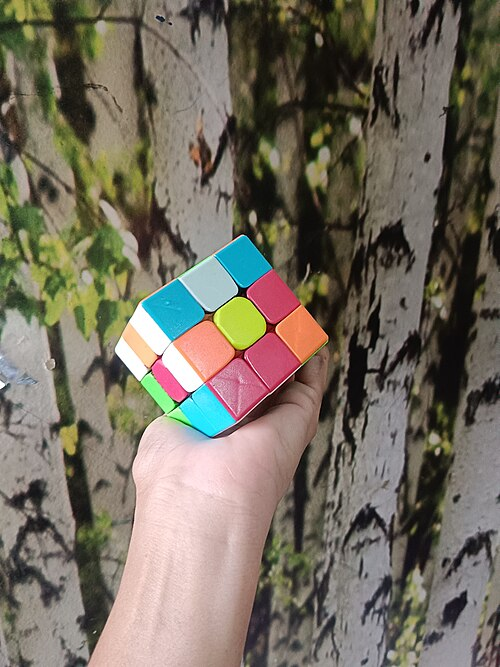
A row of coloured objects can be visually economical, but colour alone may be an unreliable way to communicate a critical difference. Adding a shape, symbol or pattern gives the player another route to recognising the objects. A physical cube puzzle is a useful visual comparison: its arrangement matters because the player can track relationships between visible faces and pieces.
The W3C’s XR Accessibility User Requirements note discusses needs including customisation, different input methods and alternatives for visual or audio information. It is an exploratory working-group note, rather than a certification checklist for games. It provides useful questions to consider when a puzzle depends on one particular way of seeing, hearing or moving.
Make actions and consequences easy to connect
After a lever is pulled, the player needs some basis for knowing what happened. A sound, movement or clear change in state can connect the action to its result. If the only response occurs behind the player’s head, an additional cue may be necessary to make that connection discoverable.
This does not mean every mystery must be explained immediately. A game can preserve uncertainty about what a mechanism ultimately does while still confirming that it registered the player’s action. That feedback helps the player test ideas deliberately instead of repeating an input simply because they are unsure whether it worked.
Let observation have its own pace
Some puzzles deliberately use time pressure. Others benefit from letting players stop, inspect the scene and reconsider their assumptions. Review the available pause, hint and movement options before deciding that speed is part of the intended challenge. Different modes may place very different demands on the same player.
When describing a VR puzzle, explain both the reasoning and the interaction. Were the clues legible? Could the player establish which object was selected? Did a failed attempt provide understandable feedback? Those details say more about the experience than the size of the virtual room. A readable puzzle gives its difficulty a clear place to live: in the problem the player is trying to solve.
![[D2] Daily Reset Thread [2021-09-07]](https://meltingtopgames.com/wp-content/uploads/2023/07/Untitled-design-2024-07-10T102422.093-1160x651.png)