
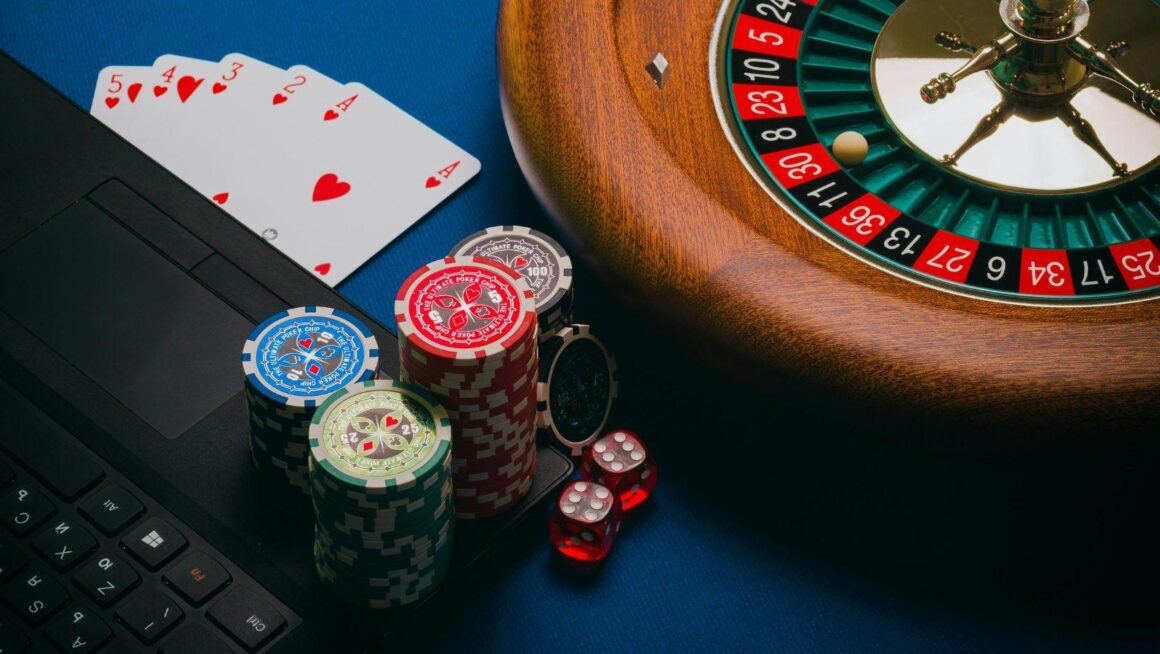
I had the realization that prompted this article in the least glamorous setting imaginable: hunched over a spreadsheet, tallying responses from a tasting panel, trying to work out whether nineteen tasters picking the odd beer out eleven times meant something or meant nothing. Somewhere around my third recalculation it hit me that I was not doing brewing science at all, in any romantic sense. I was doing casino math. The question I was really asking – “could this result have happened by dumb luck?” – is the exact question a gambler should ask before every session, and the machinery for answering it is identical: probabilities of a blind guess, expected outcomes over many trials, and the brutal honesty of variance.
Once you see the connection, you cannot unsee it, and I have come to believe each world explains the other better than either explains itself. The triangle test – our field’s workhorse for detecting whether two beers actually differ – is structurally a betting game with a one-in-three payout on pure chance. A casino, meanwhile, is essentially a giant, well-funded experiment in the null hypothesis, running millions of trials to let a tiny statistical edge express itself as guaranteed profit. The gambling industry knows this math cold, which is precisely why the analytical corner of it has grown so sophisticated – review portals in that space now publish the kind of RTP breakdowns and volatility analysis for titles like chicken road inout that would look at home in a stats textbook, because informed players demand the numbers behind the flashing lights. So pour something good, and let me walk you through the probability engine humming underneath both the tasting table and the casino floor – because understanding it will make you sharper at evaluating experiments, and considerably harder to fool about luck.
The Triangle Test Is a Casino Game (With Better Beer)
Start with the mechanics, because the parallel is not a metaphor – it is an identity. In a triangle test, a taster receives three samples: two identical, one different. Their job is to identify the odd one out. A taster with zero perceptual ability – palate-blind, guessing cold – still picks correctly one time in three, exactly as a roulette player betting a single dozen wins one spin in three with no skill whatsoever. That 1/3 is our house number, the baseline that chance alone produces, and everything in sensory statistics is built on top of it.
Now run a panel of, say, twenty-one tasters. If the two beers are truly indistinguishable, chance predicts around seven correct picks – but not exactly seven, and here is where the real statistics begin. Guessing tasters behave like a binomial process, the same distribution governing coin flips and pass-line bets, which means some panels of pure guessers will land eight, nine, even eleven correct by luck alone. The p-value we report answers one precise question: if everyone were guessing, how often would we see a result at least this extreme? When that probability drops below our threshold – conventionally 0.05 – we conclude the panel probably was not guessing, and we declare a perceptible difference.
Translate that into casino language and the statement becomes wonderfully clear: a significant triangle test is a session where the panel beat the house by more than luck plausibly allows. The null hypothesis is the casino, always assuming you have no edge; the p-value is the pit boss calculating whether your winning streak smells like skill or variance. The mapping runs deep, and it is worth laying out explicitly:
- The chance-guess rate (1/3) is the house probability – the payout structure a player with no ability faces, whether at the tasting table or betting a column at roulette.
- The null hypothesis is the house’s working assumption: no difference exists, no edge exists, and all deviations are noise until proven otherwise.
- The p-value is streak forensics – the probability that blind luck alone produced a result this impressive.
- Statistical power is bankroll depth: an underpowered panel, like an undercapitalized gambler, can hold a genuine edge and still walk away with nothing to show for it, defeated by variance before the truth emerged.
That last bullet deserves a moment, because it is the most common failure in amateur experiments and amateur gambling alike. A ten-person panel testing a subtle difference is playing a winnable game with too small a bankroll – the signal may be real, but the sample cannot outlast the noise.
House Edge and Expected Value: Why Both Houses Always Win
Flip now to the casino’s side of the table, because their math adds a concept every experimenter should internalize: expected value. Every casino game carries a house edge – a small, structural gap between true odds and paid odds. European roulette pays 35-to-1 on a bet that wins 1 time in 37, yielding an edge of about 2.7 percent; the American wheel’s extra zero pushes it past 5. Modern digital games publish the same figure inverted as RTP, return to player: a crash-style game advertising 97 percent RTP is declaring a 3 percent edge, meaning every unit staked returns, on long-run average, 0.97. No single round obeys that average – that is the seduction – but the law of large numbers guarantees the aggregate does. A casino is not gambling. A casino is harvesting a proven statistical effect across millions of trials, which is why its quarterly profits are as predictable as tide tables.
Notice what the casino is, in experimental terms: a study with astronomical sample size testing a hypothesis it already knows is true. And notice what that implies for us on the brewing side. When our experiments fail to reach significance – as many careful ones honestly do – the temptation is to read “no significant difference” as “no difference,” and that is exactly the error a gambler makes concluding a 3 percent house edge “doesn’t really matter” because last Tuesday he won. Small effects are invisible in small samples and inexorable in large ones. A process change that nudges preference by a few percentage points might never clear p < 0.05 in a twenty-taster panel, yet compounded across a commercial brewery’s entire output it is the difference between a flagship and a dumper – just as 2.7 percent, compounded across a casino floor, builds the fountains outside.
The mirror lesson runs the other way for players, and it is the most valuable sentence in gambling mathematics: expected value, not recent results, is the truth of a game. Every negative-EV game is a purchase of entertainment, priced at the edge times your total action. Understood that way – as a known cost rather than a mystery – gambling becomes an honest transaction; misunderstood, it becomes a slow experiment in the law of large numbers with your savings as the sample.
Variance, Streaks and the Lessons Each World Teaches the Other
The final shared chapter is the one humans are worst at: variance. Randomness arrives lumpy. Guessing panels produce clusters of correct answers; fair wheels produce runs of red; balanced dice throw hot streaks. Our pattern-hungry brains narrate these lumps as meaning – the panel “was on to something,” the table “went cold” – and both fields have named the resulting errors. The gambler’s fallacy expects deviation to self-correct (“red is due”); its cousin, the hot-hand illusion, expects deviation to continue. Independent trials do neither. The wheel has no memory, and neither does taster number fourteen.
Experimenters fall into a subtler version of the same trap: run enough comparisons and something will clear significance by chance alone, exactly as someone playing enough sessions will eventually hit a heater. One test in twenty going significant at p < 0.05 under a true null is not a discovery – it is the base rate. The remedies, happily, transfer perfectly between worlds, and they make a fitting closing checklist:
- Decide the analysis before the trial – pre-register your hypothesis, or set your stake and walk-away point before the first spin, so the data cannot seduce you mid-stream.
- Respect sample size – power your panels adequately, and judge any gambling or tasting result across hundreds of trials, never a memorable evening.
- Trust EV over anecdote – a process change, like a betting system, is evaluated on expectation and mechanism, not on the last thrilling result.
- Budget for variance – replicate experiments before believing them, and stake only ring-fenced entertainment money the swings cannot hurt, with hard limits doing for the player what significance thresholds do for the scientist.
What began for me as a spreadsheet epiphany has become something closer to a worldview: luck is not mystical, it is distributional, and the same handful of concepts – baseline probability, expected value, power, variance – governs whether a beer difference is real and whether a lucky night meant anything at all. The casinos mastered this math first, which is why they always win; science institutionalized it second, which is why replication beats intuition. The rest of us get to borrow it for free, and I can think of no better dual return on a little probability theory: better experiments at the brew table, and clear-eyed honesty anywhere the dice are rolling.

![[D2] Daily Reset Thread [2021-09-07]](https://meltingtopgames.com/wp-content/uploads/2023/07/Untitled-design-2024-07-10T102422.093-1160x651.png)