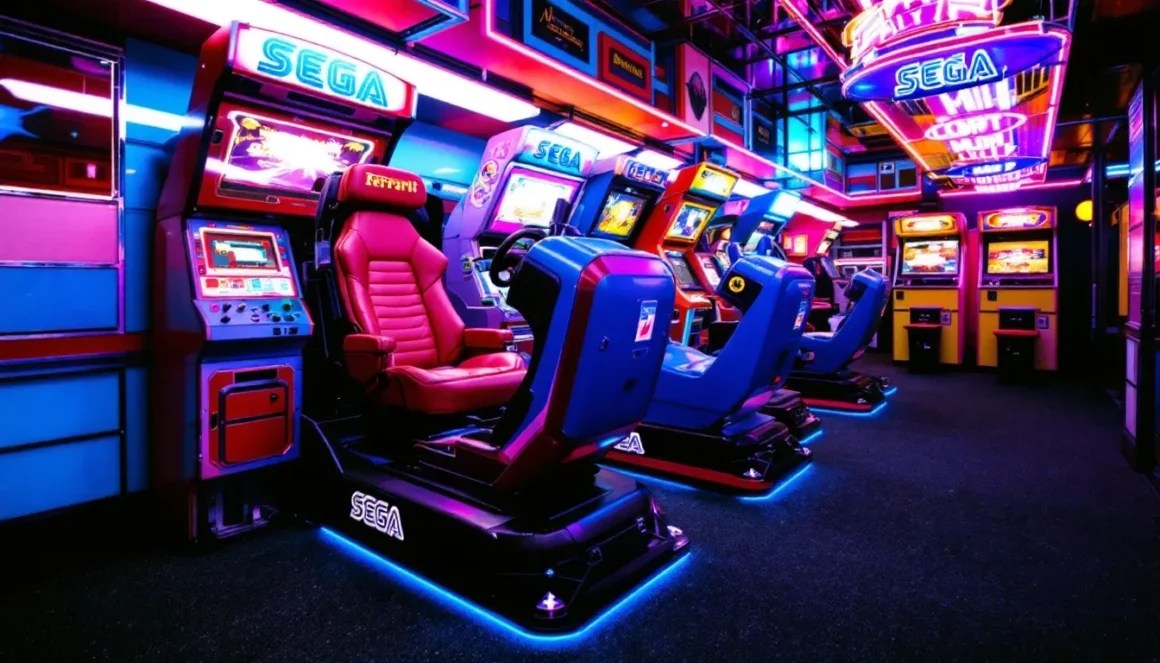
Walk into any arcade during the late ’80s or early ’90s, and you’d hear the unmistakable roar of After Burner’s jet engines, the screeching tires of Out Run, or the hydraulic hiss of a Daytona USA cabinet shifting beneath you. Sega didn’t just compete in the arcade space, they owned it. While other companies stuck to 2D sprites and joystick controls, Sega bet everything on innovation: 3D polygons, motion simulators, networked multiplayer, and cabinet designs that looked like they belonged in a science fiction film.
This wasn’t just about dropping quarters into a slot. Sega arcades were destinations. They pushed hardware boundaries so hard that home consoles spent decades trying to catch up. From Virtua Fighter redefining fighting games in full 3D to Rad Mobile quietly introducing the world to Sonic the Hedgehog before his Genesis debut, Sega’s arcade legacy runs deeper than most gamers realize.
Whether you’re hunting for a vintage cabinet to restore, trying to track down playable versions of these classics, or just curious why arcade enthusiasts still lose their minds over a working Space Harrier deluxe unit, this guide covers everything. The iconic titles everyone knows, the underrated gems worth discovering, the tech that made it all possible, and how to experience these games in 2026.
Key Takeaways
- Sega arcade games revolutionized the industry through innovative 3D graphics, hydraulic motion cabinets, and immersive designs that made arcade gaming a destination experience between the 1980s and 1990s.
- Iconic titles like Out Run, Virtua Fighter, and After Burner pioneered entire gaming genres—from pseudo-3D racing to full 3D fighting games—and remain technical benchmarks for arcade game design.
- Sega’s proprietary arcade hardware systems, including Super Scaler, Model 1, Model 2, and Model 3 boards, delivered real-time 3D rendering years before home consoles caught up.
- Virtua Fighter established competitive fighting game culture in Japanese arcades and introduced frame-data analysis that shaped modern esports and FGC strategy.
- Today, players can experience Sega arcade games through MAME emulation, official compilations like the Sega Astro City Mini, retro arcade bars, or custom-built home cabinets.
- Vintage Sega arcade cabinets remain valuable collector items, with motion-controlled deluxe units commanding $3,000–$8,000 and rare machines like R360 reaching five-figure prices.
The Golden Era of Sega Arcade Dominance
How Sega Revolutionized Arcade Gaming in the 1980s and 1990s
Sega Enterprises started as a jukebox distributor in the 1940s, but by the 1980s, they’d transformed into an arcade juggernaut that redefined what gaming hardware could do. While Nintendo focused on home consoles and Namco refined their sprite-based classics, Sega went all-in on experiential gaming, cabinets that moved, graphics that pushed technical limits, and controls that mimicked real vehicles and aircraft.
The company’s arcade division operated semi-independently from their console business, which meant they could take risks. Hang-On (1985) featured a full-size motorcycle cabinet that players actually leaned into for turns. Space Harrier (1985) put players in a moving cockpit-style seat while they blasted through psychedelic alien landscapes. These weren’t just games, they were rides.
By the late ’80s, Sega’s Model 1 and Model 2 arcade boards were delivering real-time 3D graphics years before the PlayStation or Nintendo 64 existed. Virtua Racing (1992) ran on Model 1 hardware at a smooth 60fps with texture-mapped polygons. Virtua Fighter (1993) launched the 3D fighting genre on Model 1, then Virtua Fighter 2 (1994) on Model 2 hardware became one of the highest-grossing arcade games ever made.
Sega’s arcade revenue during this period was staggering. In Japan, their arcade network dominated. In the West, their cabinets commanded premium floor space because operators knew they’d pull crowds. The company didn’t just compete with other arcade manufacturers, they set the pace everyone else scrambled to match.
Most Iconic Sega Arcade Games of All Time
Out Run and the Birth of the Racing Genre
Out Run (1986) wasn’t just a racing game, it was a fantasy. Instead of competing against AI opponents or racing toward a finish line under pressure, you cruised through scenic routes in a Ferrari Testarossa convertible with a passenger beside you. Yu Suzuki’s design philosophy prioritized feel over realism, creating a driving experience that was smooth, fast, and ridiculously satisfying.
The cabinet itself became legendary. The deluxe Out Run sit-down version featured a moving seat, force feedback steering, and a gear shift that clicked with mechanical precision. The game offered branching routes across five stages, giving players agency in a way most arcade games didn’t. The soundtrack, especially “Magical Sound Shower” and “Passing Breeze”, became iconic, cementing Out Run as a cultural touchstone beyond gaming.
Yu Suzuki built Out Run on Sega’s Super Scaler technology, which created the illusion of 3D by rapidly scaling and rotating 2D sprites. The technique produced that signature sense of speed and the way the road rolled beneath you. Even now, arcade driving games still chase the feeling Out Run nailed four decades ago.
Virtua Fighter: The 3D Fighting Game Pioneer
When Virtua Fighter dropped in arcades in 1993, it looked like nothing else. Flat-shaded polygonal characters fought in fully 3D arenas, with realistic martial arts animation captured through motion capture technology. While Street Fighter II and Mortal Kombat dominated with 2D sprites, Sega’s AM2 division bet on a completely different direction.
The game’s depth came from its three-button system: Punch, Kick, Guard. Simple inputs, but the timing and positioning created a skill ceiling that competitive players are still exploring. Each of the eight characters represented real martial arts styles, Akira’s Bajiquan, Pai’s Mizongquan, Wolf’s professional wrestling. No fireballs, no magic, just frame data and spacing.
Virtua Fighter 2 (1994) refined everything. Texture-mapped graphics on Model 2 hardware made characters look almost photorealistic for the time. The game became a phenomenon in Japanese arcades, with players studying frame advantage and combo systems years before those concepts went mainstream in the FGC. Coverage on sites like Siliconera often highlights how Virtua Fighter shaped competitive gaming culture in Japan long before esports became a household term.
After Burner and the Thrill of Jet Combat
After Burner (1987) threw players into the cockpit of an F-14 Tomcat for the most intense arcade rail shooter experience available. Yu Suzuki’s team designed it as a spiritual successor to Space Harrier, swapping fantasy landscapes for modern jet combat. The game’s hydraulic deluxe cabinet rolled, pitched, and shook as missiles screamed past and explosions filled the screen.
The cabinet experience was everything. The standard upright version was fun, but the full After Burner deluxe unit, a completely enclosed cockpit that moved on multiple axes, was unforgettable. It cost operators a fortune, but it pulled consistent quarters from players who wanted that adrenaline rush.
Gameplay was pure reflex and spectacle. Enemies swarmed from all directions, lock-on targeting let you unleash volleys of missiles, and the afterburner boost button pushed your jet to insane speeds. The game never let up, cycling through missions until your credits ran out. The soundtrack, especially that main theme, is still instantly recognizable to anyone who played it.
Daytona USA and the Multiplayer Racing Experience
If Out Run was about cruising, Daytona USA (1993) was about competition. Sega’s Model 2 hardware powered up to eight linked cabinets for multiplayer NASCAR racing, complete with a fully 3D Daytona International Speedway and opponent traffic that actually behaved like race cars instead of obstacles.
The physics felt right. Cars had weight, momentum, and required actual braking into corners. The Daytona USA cabinet featured a proper racing seat, a steering wheel with force feedback, a manual transmission, and pedals. Skilled players could drift through turns, drafting behind opponents for speed boosts, and slam into walls with satisfying, physics-based crashes.
The soundtrack became a meme decades before internet culture made that a thing. “Let’s Go Away” (commonly misheard as “Rolling Start”) and “Sky High” featured hilariously enthusiastic vocals that players either loved or couldn’t get out of their heads. The game’s charm came from how seriously it took the racing simulation while never losing that arcade accessibility.
Multiplayer setups were the real draw. Eight-player Daytona USA pods became centerpiece attractions at major arcades. The game’s success led to multiple revisions, including Daytona USA 2 (1998) and the Sega Racing Classic rerelease in 2008.
Hidden Gems and Underrated Sega Arcade Titles
Rad Mobile, Alien Storm, and Other Overlooked Classics
Not every Sega arcade game got the recognition it deserved. Rad Mobile (1991) tends to get overshadowed by Out Run, but it was a technical showcase on the Sega System 32 board with fully sprite-scaled graphics and a coastal California setting. More importantly, it featured a cameo from Sonic the Hedgehog dangling from the player’s rearview mirror, his first-ever appearance, months before Sonic the Hedgehog launched on Genesis.
The game played like a spiritual successor to Out Run, but with checkpoint racing and tighter time limits. The deluxe cabinet included a tilting seat and realistic dashboard layout. It never achieved Out Run or Daytona status, but it’s a worthy entry for any arcade game collection.
Alien Storm (1990) delivered Streets of Rage-style beat-’em-up action with a sci-fi twist. Players chose from three characters, a soldier, a flame-thrower specialist, or a robot, and blasted through alien-infested city streets. The game mixed side-scrolling brawling with first-person shooting gallery stages, keeping the gameplay varied. It received a Genesis port, but the arcade version had superior graphics and smoother animations.
Other underrated titles worth mentioning:
- Golden Axe: The Revenge of Death Adder (1992): A System 32 exclusive that never got a home port. Larger sprites, more playable characters, and branching paths made it superior to the original.
- Spikeout (1998): A 3D brawler on Model 3 hardware with four-player co-op. Think Streets of Rage meets Virtua Fighter.
- Scud Race (1996): Also known as Sega Super GT, this Model 3 racer had some of the best graphics of the ’90s arcade era. Criminally underplayed outside Japan.
- The House of the Dead series (1996-present): Light gun games that defined the genre. Cheesy voice acting and relentless zombie hordes made these arcade staples.
These games don’t get the same nostalgia treatment as Virtua Fighter or Out Run, but they represent the breadth of Sega’s arcade creativity.
The Technology Behind Sega’s Arcade Innovation
Sega’s Proprietary Arcade Hardware Systems
Sega’s arcade dominance came from relentless hardware iteration. While competitors stuck with proven tech, Sega’s engineering teams built custom arcade boards that pushed graphics, sound, and gameplay possibilities years ahead of home consoles.
Super Scaler technology (mid-to-late 1980s) powered games like Out Run, Space Harrier, and After Burner. The technique used sprite scaling and rotation to create pseudo-3D environments with impressive depth and speed. These boards included custom chips designed specifically for rapid sprite manipulation.
Model 1 (1992-1994) brought real-time 3D polygon rendering to arcades. Virtua Racing and the original Virtua Fighter ran on this hardware, delivering flat-shaded 3D at 60fps. The board featured a custom Fujitsu TGP (Texturing and Geometry Processor) chip that handled the polygon calculations.
Model 2 (1993-1998) refined 3D graphics with texture mapping, transparency effects, and higher polygon counts. Virtua Fighter 2, Daytona USA, Sega Rally Championship, and The House of the Dead all ran on Model 2 variants. The architecture became so influential that Sega’s Saturn console borrowed design elements from it.
Model 3 (1996-1999) represented peak Sega arcade tech. Games like Virtua Fighter 3, Scud Race, and The Lost World: Jurassic Park pushed polygon counts and texture quality beyond anything else in arcades. Model 3 boards could render millions of polygons per second, creating visuals that looked closer to early PlayStation 2 games than contemporary mid-’90s hardware.
Each board generation required significant operator investment, but Sega’s reputation for quality and revenue-generating games made the cost worthwhile. The company essentially controlled the high-end arcade market from 1992 through the early 2000s.
Hydraulic Cabinets and Immersive Motion Controls
Sega didn’t just innovate on graphics, they pioneered physical cabinet designs that turned games into full-body experiences. The hydraulic and motion-controlled cabinets became signature elements that separated Sega arcades from everyone else.
Hang-On (1985) started the trend with a full-size motorcycle cabinet that tilted as players leaned into turns. It was mechanically complex and expensive, but it created a sensation. Space Harrier followed with a moving cockpit seat that pitched and rolled with gameplay.
The After Burner deluxe cabinet took motion simulation further. The fully enclosed cockpit rotated 360 degrees on its axis and tilted in multiple directions, synchronized with in-game maneuvers. The setup required significant floor space and regular maintenance, but operators installed them anyway because they became destination attractions.
R360 (1990) debuted with G-LOC: Air Battle and went completely insane, a full 360-degree rotating cockpit that could flip players completely upside-down. Safety harnesses, hydraulic stabilizers, and custom software synchronized the cabinet’s rotation with the game. It was more theme park ride than arcade game, and it’s now one of the most sought-after collectible cabinets for enthusiasts with serious space and budget.
These hydraulic systems required specialized maintenance. Fluid leaks, motor failures, and sensor calibration issues meant operators needed trained technicians. Even though the hassle, the cabinets generated consistent revenue because players couldn’t replicate the experience at home, even decades later, they remain unique.
Modern arcade racing experiences still draw inspiration from Sega’s motion cabinet designs, though most contemporary setups use simpler force feedback systems rather than full hydraulics.
How to Play Sega Arcade Games Today
Modern Arcade Locations and Retro Gaming Bars
Original Sega arcade cabinets still exist in the wild, though they’re increasingly rare. Japan maintains the strongest arcade culture, with Sega-owned locations and independent operators still running classic hardware. GiGO locations (formerly Sega-branded arcades before the company sold its arcade operations) sometimes feature vintage cabinets alongside modern games.
In the US and Europe, retro arcade bars and barcades have brought classic cabinets back into public spaces. Venues like Barcade (multiple US locations), NQ64 (UK), and Ground Kontrol (Portland, Oregon) maintain working Daytona USA, Virtua Fighter, and After Burner machines. These locations often run classic games alongside craft beer menus, attracting both nostalgic gamers and curious newcomers.
Some independent arcades specialize in preservation. Funspot in New Hampshire, Galloping Ghost in Illinois, and Free Play Florida maintain extensive classic collections, including rare Sega cabinets. Calling ahead or checking their game lists online helps confirm if specific titles are available and operational.
Another option: gaming conventions and expos. Events like California Extreme, Replay FX, and Southern-Fried Gameroom Expo feature rooms full of restored arcade cabinets, including rare Sega hardware. These shows let enthusiasts play machines they’d never encounter otherwise, like working R360 units or Golden Axe: The Revenge of Death Adder cabinets.
Emulation Options and Digital Collections
Emulation provides the most accessible way to experience Sega arcade games, though it comes with caveats. MAME (Multiple Arcade Machine Emulator) supports hundreds of Sega arcade titles, with varying degrees of accuracy depending on the board and ROM dumps available.
For Model 2 and Model 3 games, Model 2 Emulator and Supermodel offer better compatibility than MAME. These specialized emulators focus on specific Sega hardware, delivering smoother performance for demanding titles like Virtua Fighter 3 or Scud Race. Configuration requires some technical knowledge, mapping controls, adjusting graphics settings, and locating correct ROM files, but the results are solid.
Officially licensed collections provide legal, convenient alternatives:
- Sega Astro City Mini: A miniature arcade cabinet with 36 pre-loaded games, including Golden Axe, Alien Storm, and Virtua Fighter. Released in 2020, it’s plug-and-play but features a tiny screen (under 4 inches).
- Yakuza series: Sega’s action-RPG franchise includes fully playable arcade games at in-game arcades. Yakuza 0 and Yakuza Kiwami feature Out Run, Space Harrier, and others.
- Sega Ages series (Nintendo Switch): Digital releases of classic games optimized for modern hardware, including Out Run, Virtua Racing, and Thunder Blade.
- Judgment and Lost Judgment: These spin-offs from the Yakuza team include playable versions of Virtua Fighter 2 and other classics.
According to coverage on Game Rant, several compilation releases and remasters have brought Sega arcade titles to modern platforms, though licensing and technical challenges mean many games remain unavailable through official channels.
Home Arcade Cabinets and Replica Machines
For players who want the physical experience without hunting for vintage hardware, replica cabinets and home arcade solutions have improved significantly in recent years.
Arcade1Up produces 3/4-scale replica cabinets pre-loaded with licensed games. Their Sega lineup includes Out Run, Space Harrier, and Golden Axe cabinets. These units cost $400-$600, feature authentic artwork and controls, but use LCD screens instead of CRT monitors. The controls are functional but not arcade-quality, serious players often mod them with better joysticks and buttons.
AtGames Legends series offers tabletop and upright arcade machines with larger game libraries. Build quality varies, and the emulation isn’t always perfect, but they’re affordable entry points for casual players.
For enthusiasts willing to invest more, custom-built cabinets running MAME or dedicated emulators provide the most authentic home experience. Communities on forums like KLOV (Killer List of Videogames) and Arcade Controls share build guides, control panel layouts, and wiring diagrams. A proper custom build includes:
- A genuine CRT monitor (for scan-line authenticity) or high-refresh LCD with minimal lag
- Sanwa or Seimitsu arcade joysticks and buttons
- A PC or Raspberry Pi running emulation software
- Custom control panels wired for specific game types (driving wheels, flight sticks, etc.)
Costs range from $800 for basic builds to $3,000+ for premium setups with original arcade components. The advantage is complete control over game selection, display quality, and authentic arcade controls.
Some companies specialize in turnkey solutions. Dream Arcades, RecRoom Masters, and Innovative Concepts in Entertainment (ICE) build custom cabinets with professional-grade components and installation. These setups start around $2,500 but deliver showroom-quality results without the DIY effort.
Collecting and Preserving Sega Arcade Cabinets
What to Look for When Buying Vintage Sega Arcade Games
Buying a vintage Sega arcade cabinet is part investment, part restoration project, and part gamble. Prices vary wildly based on condition, rarity, and whether it’s a standard upright or deluxe motion cabinet. Here’s what to evaluate before pulling the trigger:
Cabinet condition: Check for water damage, wood rot, and structural integrity. Side panels, control panel overlays, and marquees should be intact and legible. Reproduction parts exist for popular titles, but original components increase value. Inspect for cigarette burns, stains, and faded artwork, cosmetic restoration is possible but time-consuming.
Monitor functionality: CRT monitors are the heart of arcade authenticity, but they’re aging hardware. Test for brightness, color accuracy, burn-in, and geometry issues. Replacing or refurbishing a CRT requires specialized knowledge. Some collectors swap in LCD monitors with scanline filters, but purists consider this sacrilege.
PCB (Printed Circuit Board) health: The game board itself determines whether the machine plays correctly. Test every input, buttons, joysticks, steering wheels, pedals, and watch for graphical glitches, sound issues, or boot failures. Battery-backed SRAM chips can leak and damage boards. Replacement boards or repair services exist but add significant cost.
Control hardware: For driving games, check force feedback functionality, pedal resistance, and gear shift mechanisms. For hydraulic cabinets like After Burner or Space Harrier, test all motion axes and listen for unusual noises from motors and pumps.
Power supply: Arcade games run on different voltage standards depending on region. Verify compatibility with your local power and check for failing capacitors, which are common in aging electronics.
Rarity and pricing: Standard uprights for games like Golden Axe or Altered Beast typically run $500-$1,500 depending on condition. Sit-down or motion cabinets like Out Run deluxe or After Burner command $3,000-$8,000. Rare machines like R360 or Golden Axe: The Revenge of Death Adder can hit five figures when they surface.
Sources for buying:
- Auctions and estate sales: Occasionally yield unexpected finds at reasonable prices
- KLOV forums and specialized Facebook groups: Connect buyers with sellers in the collector community
- Arcade auction sites: Like Vintage Arcade Superstore or Arcade Specialties
- Local operators and warehouse liquidations: Sometimes offload old inventory
Avoid impulse purchases. Arcade cabinets are heavy (200-800 pounds for uprights, 500-1,500 pounds for deluxe cabinets), require truck transport, and need climate-controlled storage. Factor in restoration costs and ongoing maintenance.
Maintenance Tips for Keeping Your Cabinet Running
Owning a vintage Sega arcade cabinet means committing to ongoing maintenance. These machines were built for commercial operation, but decades of use and aging components require attention.
Monitor care: CRT monitors need occasional degaussing to eliminate color distortion. Check for loose connections on the chassis and inspect capacitors for bulging or leaking. Keep the screen clean with appropriate cleaners, never use ammonia-based products. If brightness fades, the tube may need a cap kit replacement or professional refurbishment.
Control maintenance: Joysticks and buttons wear out with use. Microswitches inside buttons fail and need replacement. Joystick springs lose tension and should be swapped. Driving games require periodic lubrication of steering mechanisms and calibration of force feedback motors. Pedals accumulate dust and grime, disassemble and clean them annually.
PCB preservation: Store spare batteries for battery-backed RAM chips and replace them every 3-5 years before they leak. Clean board contacts with isopropyl alcohol and a soft brush. Reseat socketed chips periodically to prevent oxidation. For games running on older hardware, consider having backup PCBs or keeping ROM dumps for emergencies.
Hydraulic systems: For motion cabinets, check hydraulic fluid levels regularly and inspect hoses for leaks or cracks. Motors and pumps require periodic servicing. Sensor calibration ensures smooth, synchronized movement. These systems are complex, document everything and keep service manuals handy.
Climate control: Arcade cabinets hate humidity and temperature swings. Store machines in climate-controlled environments to prevent wood warping, PCB corrosion, and capacitor failures. Avoid basements prone to flooding or dampness.
Routine cleaning: Dust accumulates inside cabinets and clogs cooling fans. Open the back panel every few months and vacuum or blow out dust from PCBs, monitors, and power supplies. Wipe down exterior surfaces and apply appropriate wood treatments to maintain finish.
Join collector communities for troubleshooting advice. Forums like Arcade-Museum, KLOV, and Reddit’s r/cade offer diagnostic help, repair guides, and part sourcing recommendations. Understanding different types of arcade games and their specific maintenance needs helps prioritize care routines.
The Legacy and Cultural Impact of Sega Arcades
Sega’s arcade innovations didn’t just influence gaming, they shaped entertainment technology and design philosophy across industries. The hydraulic cabinets pioneered by Hang-On and After Burner became templates for theme park simulators and military training equipment. The 3D graphics technology developed for Model 2 and Model 3 boards influenced early GPU design and real-time rendering techniques used in film and visualization.
Competitive gaming culture owes a significant debt to Virtua Fighter. Japanese arcades turned Virtua Fighter 2 into a genuine spectator sport, with crowds gathering around skilled players, tournaments drawing massive audiences, and strategy guides selling like bestsellers. The frame-data-focused competitive analysis that defines modern fighting games started with Virtua Fighter players dissecting move properties frame by frame. Sites like Gematsu continue to cover how this arcade legacy influences contemporary fighting game communities in Japan.
Sega’s arcade design philosophy, build hardware that delivers experiences impossible at home, runs counter to the current industry direction. Modern arcades struggle because home hardware matches or exceeds what most arcade cabinets offer. But Sega proved there’s value in the physical, the tactile, the social experience of playing in a dedicated space with specialized controls.
The aesthetic influence persists too. Outrun aesthetics, neon sunsets, palm trees, Ferrari convertibles, and synthwave soundtracks, became an entire visual genre that’s exploded in indie games, music, and design. Daytona USA’s goofy earnestness and infectious soundtrack inspired countless racing games to embrace personality over photorealism.
In terms of arcade game appeal, Sega demonstrated that innovation, spectacle, and quality gameplay could coexist. They didn’t chase trends, they set them. When home consoles finally caught up to arcade technology in the late 2000s, Sega’s arcade division had already moved into redemption games and UFO catchers, but their golden era output remains the benchmark for what arcade gaming could be at its peak.
Many developers who worked on Sega’s arcade titles went on to influential roles in the industry. Yu Suzuki created Shenmue after his arcade work, bringing that same attention to detail and experiential design to open-world gaming. AM2 developers spread across the industry, carrying Sega’s design philosophies to new projects and studios.
The preservation challenge is real. Many of Sega’s arcade boards are aging out, ROM dumps aren’t always complete or accurate, and the physical cabinets, especially motion units, require specialized knowledge to maintain. Organizations like The National Videogame Museum and The Strong Museum of Play have started archiving significant examples, but thousands of cabinets are being scrapped or left to decay in storage.
For a generation of gamers, Sega arcades weren’t just where you played games, they were where you discovered that games could be more than pixels on a screen. They could move you, literally and figuratively.
Conclusion
Sega’s arcade legacy is more than nostalgia, it’s a masterclass in hardware innovation, game design, and understanding what makes a play experience worth paying for. From the genre-defining Out Run and Virtua Fighter to the sensory overload of After Burner’s hydraulic cabinets, Sega built machines that justified leaving the house and standing in line with a pocket full of quarters.
Whether you’re tracking down original hardware, diving into emulation, or just appreciating the history, Sega’s arcade catalog remains essential gaming. The technology they pioneered, the design philosophies they championed, and the sheer joy they delivered influenced decades of games that came after. In an era when most gaming happens on devices that fit in your pocket, there’s something irreplaceable about a massive cabinet with a steering wheel that fights back or a motion cockpit that throws you around like you’re actually in a jet.
If you’ve never experienced these games in their original cabinet form, seek them out. Find a retro arcade bar, attend a gaming expo, or build your own setup. The gameplay holds up, the innovation still impresses, and the experience, even decades removed from their heyday, still delivers.