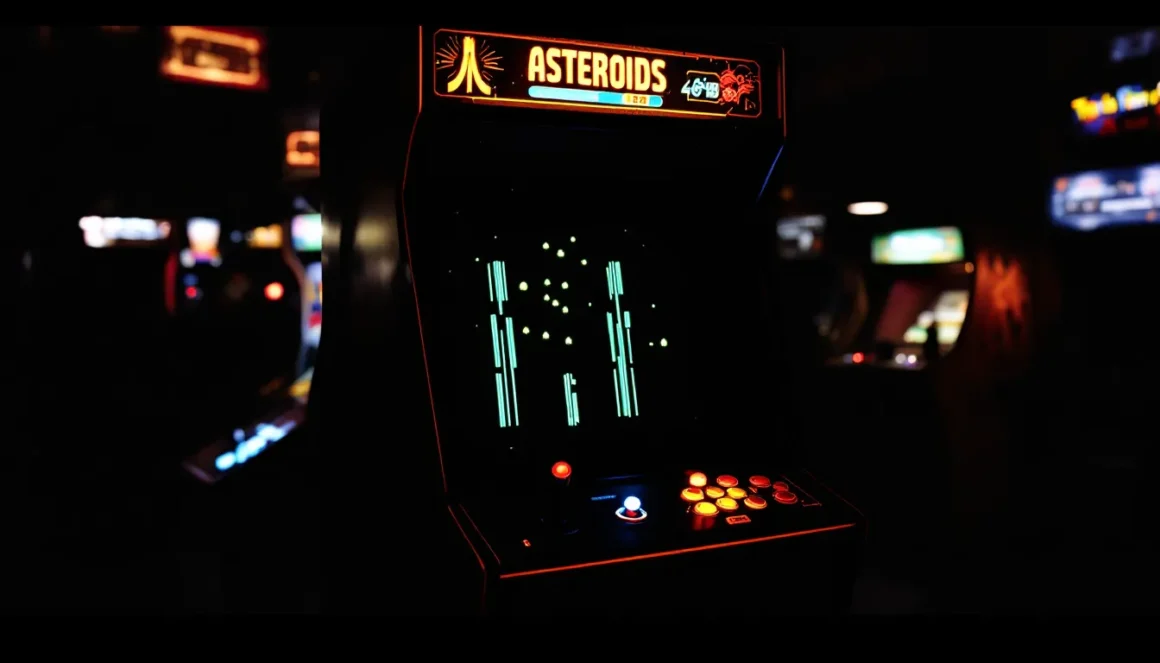
Walk into any retro gaming bar today and you’ll hear the distinct bleeps and bloops of machines from the late ’70s and early ’80s. Atari’s arcade cabinets defined what gaming could be, quarter-munching experiences that demanded skill, patience, and just one more try. Before home consoles dominated living rooms, Atari ruled dimly lit arcades with vector graphics, simple controls, and gameplay loops designed to separate you from your pocket change as efficiently as possible.
This wasn’t just entertainment. Atari’s arcade machines established design principles still used today: immediate accessibility paired with brutal difficulty curves, high score tables that fueled competition, and audiovisual feedback that made every action feel significant. Whether you’re hunting for nostalgia or trying to understand why these decades-old games still matter, this guide covers everything from Atari’s technological breakthroughs to where you can play these classics right now.
Key Takeaways
- Atari arcade games revolutionized the gaming industry by establishing design principles—immediate accessibility, brutal difficulty curves, and high score competition—that still influence modern gaming across mobile, indie, and esports platforms.
- Vector graphics and specialized controllers like trackballs and spinners enabled Atari arcade games to deliver innovative gameplay that defined entire genres and remain technically impressive for their era.
- Iconic Atari arcade games like Asteroids, Centipede, and Tempest combined simple controls with deep mastery potential, proving that elegant rulesets can sustain hundreds of hours of competitive play and pattern memorization.
- High score tables transformed Atari arcade games into persistent social competitions, creating local legends and asynchronous multiplayer experiences in shared arcade spaces that online leaderboards still can’t fully replicate.
- You can play classic Atari arcade games today through official collections like Atari 50, MAME emulation, browser-based options, or restored cabinets at retro gaming bars without owning original hardware.
- Atari arcade games endure because their design constraints forced clarity and finished gameplay that modern development lacks—these are complete works immune to patches, updates, or balance changes that define contemporary gaming.
The Rise of Atari in the Arcade Revolution
How Atari Shaped the Gaming Industry
Atari didn’t invent video games, but they commercialized them in ways that made the entire industry possible. Founded in 1972 by Nolan Bushnell and Ted Dabney, Atari turned arcade gaming from a laboratory curiosity into a billion-dollar phenomenon. Pong proved that simple mechanics could print money, and the company rapidly expanded from there.
The arcade division operated differently than the home console business. Cabinets needed to earn back their cost within weeks, which meant gameplay had to hook players immediately while keeping sessions short enough to maintain turnover. Atari mastered this balance, creating games that were easy to learn but nearly impossible to master. Their designs influenced competitors and established templates still visible in modern mobile gaming’s monetization strategies.
By the late ’70s, Atari controlled roughly 60% of the arcade market. They didn’t just make games, they created the infrastructure around them, from standardized cabinet designs to coin mechanisms that arcade operators relied on. When you see modern indie games embracing arcade-style scoring systems, they’re borrowing from frameworks Atari established.
The Technological Innovations Behind Atari’s Success
Atari’s engineers worked within brutal hardware constraints, which forced creative solutions that defined gaming aesthetics for generations. Vector graphics, used in titles like Tempest and Asteroids, drew glowing lines directly on the monitor rather than filling in pixels. This gave games a distinctive look while allowing smoother movement than raster graphics could manage at the time.
The Atari POKEY sound chip, introduced in 1979, gave games like Centipede their characteristic audio personality. Four independent sound channels allowed overlapping effects, crucial when you needed distinct audio cues for mushrooms, spiders, and the centipede itself, all happening simultaneously. Players learned to react to sound as much as visuals, a design principle still fundamental in competitive gaming.
Atari also pioneered the trackball controller with Centipede and Football, offering analog precision in an era dominated by digital joysticks. The evolution of arcade controls across different game types shows how hardware innovation directly shaped genre development. These weren’t just different input methods, they were new ways to play.
Most Iconic Atari Arcade Games of All Time
Pong: The Game That Started It All
Pong (1972) was Atari’s first commercial success and gaming’s first mainstream hit. Two paddles, one ball, first to 11 points wins. The genius wasn’t complexity, it was feedback. The ball made a satisfying beep on paddle contact, with the pitch varying based on impact angle. Players could control shot trajectory, adding depth that kept them feeding quarters long after the novelty wore off.
The arcade version earned $1,200-$1,500 weekly per unit, roughly 4-6 times what a typical jukebox generated. Bars and bowling alleys installed Pong cabinets because they were reliable money-makers that didn’t require explanation. That accessibility established the arcade as a viable business model and gave Atari the capital to develop more ambitious titles.
Asteroids: Space Shooting Perfection
Released in 1979, Asteroids became Atari’s best-selling arcade game with over 70,000 cabinets produced. The vector graphics allowed for smooth rotation and a sense of momentum that felt futuristic compared to earlier games. Your ship drifted according to actual physics, thrust built velocity, rotation didn’t automatically adjust your trajectory.
The wrapping screen boundaries turned defensive play into a gamble. Flying off one edge meant appearing on the opposite side, which could save you or drop you directly into a rock field. Major gaming outlets have consistently ranked Asteroids among the most influential arcade titles, and for good reason, it introduced permanent high score saves, making every game an attempt to leave your mark on the machine.
Players discovered that different types of arcade games demanded different skill sets, and Asteroids rewarded spatial awareness and risk calculation over raw reflexes. The split-second decision to shoot a large asteroid or dodge it created endless variation within a simple ruleset.
Centipede: The Bug-Blasting Classic
Centipede (1981) was designed by Dona Bailey, one of the first women game designers in the industry, alongside Ed Logg. The trackball controller allowed for precise aiming across the playfield, letting you thread shots through gaps in the mushroom field while tracking multiple threats.
The centipede itself descended from the top of the screen in segments that could split into independent enemies if you shot the body instead of the head. Spiders bounced unpredictably through your defensive mushrooms, scorpions poisoned mushrooms to make the centipede dive toward you faster, and fleas dropped additional mushrooms when you cleared too many. Every enemy affected the playfield state, creating emergent complexity.
Centipede attracted a more diverse player base than most arcade games of its era, with roughly 50% of players being women, unusual for early ’80s arcades. The game’s deliberate pace and strategic elements made it approachable while maintaining depth that kept experts returning.
Missile Command: Cold War Anxiety Meets Gaming
Missile Command (1980) tapped into genuine cultural anxiety. You defended six cities from incoming nuclear missiles using a trackball to aim your counter-missiles. The trackball controlled a crosshair while three fire buttons launched from different bases, forcing you to manage ammunition and positioning simultaneously.
As levels progressed, missiles split into multiple warheads, smart bombs evaded your defenses, and satellites dropped additional threats. The game was deliberately unwinnable, your cities would eventually fall no matter how skilled you became. That design decision reinforced the Cold War message: nuclear war couldn’t be won, only delayed.
Designer Dave Theurer later admitted he had nightmares about nuclear war while developing the game. That psychological weight translated into gameplay tension rare for the era. The iconic “THE END” screen, showing your destroyed cities, hit differently than a typical game over message.
Tempest: Vector Graphics at Their Finest
Tempest (1981) pushed vector graphics to their limit with 3D-style gameplay on varied geometric playfields. You controlled a ship moving around the rim of shapes like tubes, circles, and hourglasses, shooting down into the center at enemies crawling toward you. The Atari spinner controller (a continuous-rotation knob) allowed for lightning-fast repositioning around the rim.
Each of the 16 level shapes changed optimal strategy. Closed loops let you circle to evade, while open patterns required more defensive play. Enemies had distinct behaviors: Flippers blocked shots and eventually climbed out to chase you, Fuseballs trapped you if they reached the rim, Spikers turned lanes dangerous if you let them climb too far.
Tempest earned its reputation as one of the hardest arcade games Atari released. The difficulty curve was punishing, the visual information overwhelming, and the speed requirements extreme. But players who invested time found incredible depth in lane management, enemy prioritization, and Superzapper timing (a limited-use smart bomb that cleared the current level of all enemies).
Gameplay Mechanics That Defined a Generation
Simple Controls, Deep Mastery
Atari’s arcade games typically used one joystick and one or two buttons, minimal input complexity compared to modern controllers with 14+ buttons. This wasn’t a limitation but a design philosophy. Asteroids gave you rotate left, rotate right, thrust, fire, and hyperspace. That’s it. Yet mastering thrust management, rotation timing, and defensive hyperspace jumps took hundreds of hours.
The control simplicity meant anyone could start playing within seconds of dropping a quarter. No tutorial, no practice mode, no difficulty select. You learned by playing, and the game killed you quickly enough that lessons stuck. Modern roguelikes owe a debt to this approach, permadeath is meaningful when you can immediately start another run.
Physical controls mattered too. The evolution of arcade driving mechanics shows how input devices shaped entire genres. Atari’s trackballs and spinners offered analog precision that standard joysticks couldn’t match, creating design possibilities that defined games rather than just controlling them.
The Addictive High Score Chase
High score tables turned single-player games into asynchronous multiplayer competitions. Your three initials stayed on the machine until someone beat your score, creating persistent bragging rights. Arcades developed local legends, the player with the untouchable Asteroids score, the Centipede wizard who always held the top spot.
Atari implemented score displays with deliberate psychological hooks. Leading zeroes made scores feel bigger (0000100 rather than 100). Extra lives granted at specific point thresholds encouraged risky play to reach the next bonus. Score multipliers rewarded clean play, like Asteroids’ bonus for clearing waves without dying.
The competitive element was physical and social in ways online leaderboards can’t replicate. You saw skilled players in person, watched their techniques, and learned through observation. Why arcade games retained their appeal largely comes down to this social dimension, they were communal experiences in a shared physical space.
The Cultural Impact of Atari Arcade Games
From Arcades to Pop Culture Phenomenon
By 1981, Americans spent more money on arcade games than they did on movies and casinos combined, approximately $5 billion annually. Atari’s games appeared everywhere from truck stops to shopping malls. The distinctive cabinet art, attract-mode sounds, and glowing screens became cultural touchstones that defined the early ’80s as much as any music or fashion trend.
Arcades became teen hangouts, which naturally attracted moral panic. Municipalities passed ordinances limiting arcade locations near schools or restricting hours for minors. The controversy only increased visibility, when your game got mentioned in news segments about America’s youth going astray, you’d successfully penetrated mainstream consciousness.
Atari’s influence extended beyond gaming. The vector graphics aesthetic influenced graphic design and MTV-era music videos. Films like Tron (1982) brought arcade culture to the big screen. When Shacknews covered retro gaming’s cultural footprint, they noted how Atari’s design language became visual shorthand for “the future” throughout the ’80s.
Competitive Gaming Before Esports
Tournaments existed before Twitch or prize pools measured in millions. The 1980 Space Invaders Championship attracted over 10,000 participants, but Atari games drove much of the competitive scene that followed. Twin Galaxies, founded in 1981, began tracking world records for arcade games, with Atari titles dominating the early lists.
Walter Day’s Twin Galaxies scoreboard gave competitive arcade gaming legitimacy and standardized rules. Players submitted videotaped runs for verification, establishing the documentation standards modern speedrunning communities still use. Billy Mitchell’s 1999 perfect Pac-Man game may get more attention, but John McAllister’s Asteroids score of 41,336,440 (set in 2010 after a 58-hour session) shows the depth still being discovered in these decades-old games.
The crafting of DIY arcade cabinets by dedicated fans today continues this competitive tradition, with enthusiasts building authentic hardware specifically for score chasing on original PCBs.
How to Play Atari Arcade Games Today
Official Collections and Re-Releases
Atari has released multiple compilation collections across modern platforms:
- Atari 50: The Anniversary Celebration (2022), Available on PC, PS5, PS4, Xbox Series X
|
S, Xbox One, and Switch. Includes over 100 games with documentary-style presentations, making it the most comprehensive official option. The emulation quality is solid, though purists note input lag on some titles.
-
Atari Anthology (PS2, Xbox, PC), Older but more affordable collection featuring 85 arcade and 2600 titles. Still holds up if you’re not chasing frame-perfect accuracy.
-
Atari Vault (PC via Steam), 100 games with online multiplayer for select titles. Performance varies by game, but community mods have improved compatibility on modern systems.
Official releases handle licensing cleanly and support the rights holders, but they’re not always the most accurate recreations. Emulation enthusiasts debate whether commercial collections capture the original timing and physics precisely enough for serious play.
Emulation and Browser-Based Options
The MAME (Multiple Arcade Machine Emulator) project has meticulously documented arcade hardware for decades. MAME accurately reproduces Atari’s original arcade PCBs, down to CPU timing and sound chip behavior. You’ll need ROM files (the actual game code), which exist in legal gray areas, technically you should own the original PCB to legally dump and use the ROM.
MAME setup requires some technical comfort. You’ll need:
- Current MAME version (0.262 as of early 2026)
- Matching ROM sets for your MAME version
- Control mapping for keyboard or gamepad
- Configuration tweaks for shaders if you want CRT scanline effects
Browser-based options via Internet Archive offer legal, immediate access to many Atari classics. The emulation quality varies and controls feel mushy without proper gamepad mapping, but it’s perfect for casual nostalgia trips or introducing someone to these games.
Arcade Cabinets and Retro Gaming Bars
Original Atari cabinets show up at vintage gaming stores, estate sales, and specialty arcade auctions. Expect to pay $500-$2,000 for working cabinets depending on title, condition, and local market. Asteroids and Centipede cabinets are relatively common: Tempest commands premium prices due to lower production numbers.
Maintenance requirements are real, these are 40+ year old machines. Capacitors dry out, monitors need occasional adjustment or replacement, PCBs fail. Unless you’re comfortable with electronics repair or have access to an arcade tech, budget for professional servicing.
Retro gaming bars have exploded in popularity over the past decade. Cities across North America now have arcade-focused venues featuring restored cabinets on free play. These locations let you experience the games as originally intended, standing in front of the actual cabinet, using the proper controls, in a social environment, without the ownership headaches.
Tips and Strategies for Mastering Atari Classics
Pattern Recognition and Memorization
Atari games used pseudo-random patterns that repeated based on starting conditions. Expert players memorized these patterns, transforming seemingly chaotic gameplay into executable strategies.
Asteroids, Large asteroids always split into the same configuration of medium rocks. Learning the split patterns lets you position before breaking them, controlling where threats appear rather than reacting after the fact. Optimal play involves clearing one side of the screen methodically while using the wrap-around to escape when necessary.
Centipede, The centipede’s path is deterministic based on mushroom placement. You can guide it by strategically clearing mushroom rows, forcing it into patterns that keep it away from the bottom of the screen longer. Advanced players memorize spider spawn timing to minimize mushroom disruption.
Missile Command, Early waves have fixed attack patterns. Memorizing the incoming trajectories lets you pre-position your crosshair and fire defensively rather than reactively. This becomes crucial in later levels where the volume of incoming missiles exceeds your ability to track them visually.
High Score Techniques for Popular Titles
Asteroids Advanced Strategies:
- Lurking, Destroying all asteroids except one small rock, then hunting UFOs for higher point values. UFOs appear at fixed time intervals, and their point value (200 or 1,000) is more lucrative than breaking rocks. Top scores are built on extended UFO hunting phases.
- Hyperspace management, Hyperspace is safest when the screen is clear, since you randomly reappear. Use it as a panic button early on, but save it for calculated escapes once you’ve developed spatial awareness.
- UFO shot prediction, Large UFOs fire randomly, small UFOs aim at your ship. Learning to bait small UFO shots while dodging gives you openings to fire back.
Centipede Score Maximization:
- Mushroom farming, Let the flea drop mushrooms in controlled areas, then clear them for points. This extends playtime and builds score between centipede waves.
- Spider manipulation, Spiders have three speed settings. The slow spider is worth 900 points at close range. Learning to recognize and engage slow spiders dramatically boosts scoring rate.
- Head shots, Always aim for the centipede head (the segment with a face). Destroying the head is worth 100 points versus 10 for body segments, and it prevents the centipede from splitting into multiple threats.
Missile Command Efficiency Tips:
- Base management, Your three bases have limited ammo. Prioritize center base fire for central threats, reserving outer bases for edge threats. Running one base dry while others remain stocked is better than depleting all three evenly.
- Smart bomb conservation, Smart bombs (via enemy planes) are best saved for overwhelming situations, not wasted on manageable waves.
- City prioritization, The three center cities are worth more end-of-level bonus points. If you must sacrifice cities, lose the outer ones first.
Many of these techniques are documented by competitive gaming communities that continue analyzing decades-old titles for optimization opportunities.
The Legacy of Atari Arcade Games in Modern Gaming
Influence on Contemporary Game Design
Modern indie games borrow heavily from Atari’s design philosophy. Geometry Wars is essentially Asteroids with twin-stick controls and particle effects. Super Hexagon takes Tempest’s geometric playfields and distills them into pure pattern recognition. Luftrausers applies Asteroids’ momentum physics to a side-scrolling shooter.
The roguelike boom owes a conceptual debt to arcade design: short runs, permadeath, immediate restarts, and score-chasing. Games like Spelunky and Hades use Atari’s template of simple controls masking deep systems, where mechanical execution matters less than understanding game state and making smart moment-to-moment decisions.
Mobile gaming’s monetization strategies directly descend from quarter-munching arcade design. The “just one more try” loop, sessions designed to last 2-5 minutes, and difficulty curves calibrated to hit exactly when players are most emotionally invested, these weren’t invented by mobile developers. Atari figured out the psychology in 1979, they just collected quarters instead of displaying IAP prompts.
Why Retro Gaming Continues to Thrive
Retro gaming isn’t pure nostalgia. These games endure because their design constraints forced clarity that modern development often lacks. You can explain Asteroids in 15 seconds. You can master the controls in 30 seconds. But you’ll spend years learning optimal strategies.
The lack of updates, patches, or balance changes means these games are finished works. The Tempest you play today is identical to the one from 1981. In an era where games launch incomplete and get reworked through years of patches, there’s appeal in something fixed and knowable.
The ongoing appeal of arcade experiences also reflects modern gaming’s complexity fatigue. After finishing a 100-hour open-world game with seventeen interconnected systems, sometimes you just want to shoot rocks in space for fifteen minutes. Atari’s games deliver that perfectly.
Conclusion
Atari’s arcade legacy isn’t about nostalgia, it’s about understanding what made these games work when every design decision was constrained by 1970s hardware limitations and the need to earn quarters in hostile pizza parlor environments. The lessons they established about immediate accessibility, skill ceiling depth, and competitive hooks remain relevant whether you’re analyzing battle royale design or understanding why mobile games structure sessions the way they do.
These games still hold up because their core loops were refined through thousands of hours of real-world player testing in actual arcades. No focus groups, no analytics dashboards, just whether the machine earned money or collected dust. That market pressure produced designs that respected players’ time while demanding their skill, a balance modern gaming frequently struggles to maintain. Whether you’re chasing world records on original hardware or casually playing browser ports during lunch breaks, Atari’s arcade catalog offers a masterclass in game design fundamentals that haven’t aged a day.