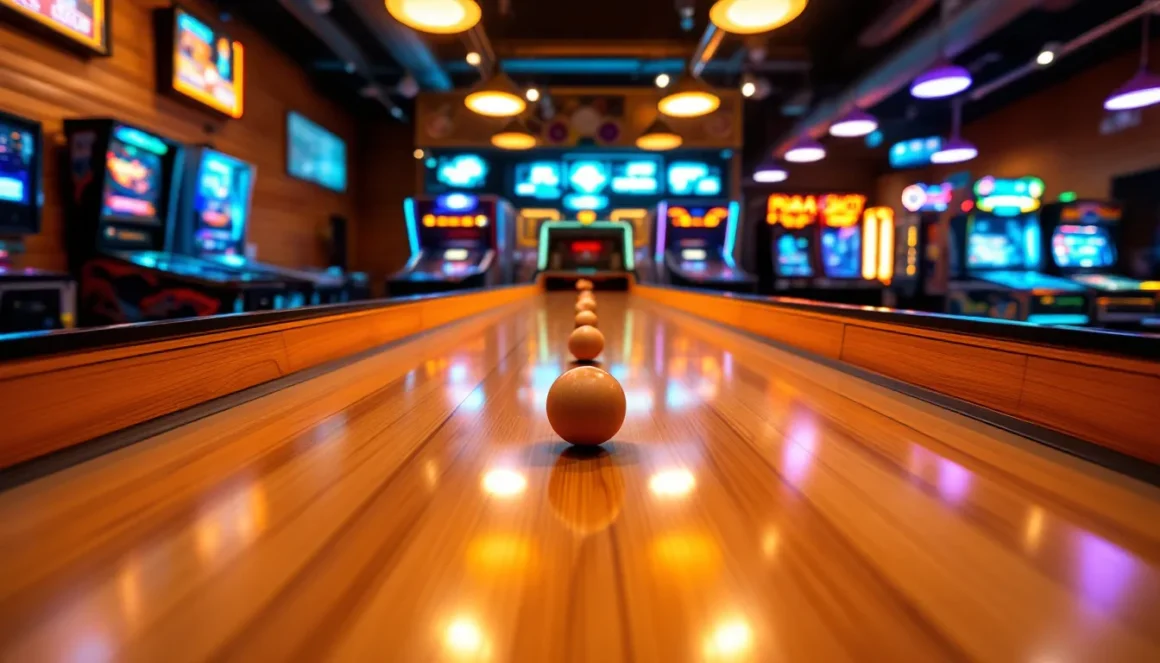
The satisfying crack of a pinball hitting bumpers. The precise arc of a Skee-Ball sailing into the 100-point hole. The rhythmic bounce of a pixel ball breaking through brick formations. Ball-based arcade games represent some of gaming’s most enduring and universally appealing experiences, blending simple physics with challenging skill tests that hook players across generations.
These games stripped away complex controls and elaborate narratives, leaving pure mechanical satisfaction. Whether you’re launching physical spheres down wooden lanes or controlling digital balls with pixel-perfect precision, the core appeal remains unchanged: master the physics, nail the timing, chase the high score. From the earliest days of Pong to today’s ticket-spitting redemption machines, ball arcade games have proven their staying power in an industry obsessed with the next big thing.
This guide dives into the world of ball-based arcade entertainment, covering the classics that defined the genre, modern iterations keeping arcades alive, and strategies to dominate every roll, bounce, and launch you encounter.
Key Takeaways
- Arcade games with balls blend simple physics with challenging skill tests, from classic pinball and Skee-Ball to modern digital brick-breakers, making them universally appealing across generations.
- Timing, aim, and physics understanding are critical to mastering ball arcade games—develop consistent muscle memory and learn trajectories to separate casual play from high-score championship performance.
- Modern arcades combine physical ball games like Skee-Ball and pinball with contemporary ticket redemption and digital experiences, while home versions via emulation, virtual pinball cabinets, and console releases make the genre accessible to everyone.
- Ball arcade games endure because they offer irreplaceable tactile satisfaction, skill-based progression, and social engagement that digital-only entertainment cannot replicate in shared physical spaces.
What Are Arcade Games with Balls?
Ball arcade games center on one simple mechanic: players interact with spherical objects, physical or digital, to achieve specific objectives. The ball serves as both the primary game element and the main source of challenge, requiring players to control trajectory, velocity, timing, or positioning.
These games split into two categories. Physical ball games use actual spheres, wooden, rubber, steel, or plastic, that players roll, throw, or launch. Skee-Ball exemplifies this perfectly: you roll nine balls up a ramp, aiming for scoring rings with varying point values. Digital ball games feature on-screen representations where buttons, paddles, or joysticks control movement. Breakout fits here, with players bouncing a pixel ball to destroy brick patterns.
The defining characteristic across both types is accessibility. Ball games require minimal explanation, see ball, control ball, score points. This immediate comprehension made them arcade staples, perfect for casual players dropping a quarter while waiting for friends and dedicated enthusiasts grinding for world records. The physics feel intuitive because they mirror real-world expectations, even when game rules bend reality for entertainment value.
Most ball arcade games incorporate escalating difficulty through speed increases, pattern complexity, or target precision requirements. Success depends on reading trajectories, developing muscle memory, and maintaining composure as chaos intensifies, skills that translate across the entire genre.
The History and Evolution of Ball-Based Arcade Games
From Pinball Machines to Digital Classics
Pinball machines dominated American arcades, bars, and bowling alleys from the 1930s through the 1970s, establishing ball-based entertainment as a commercial juggernaut. Early machines were purely mechanical, springs, bumpers, and gravity did all the work. The introduction of flippers in 1947 (Gottlieb’s Humpty Dumpty) transformed pinball from luck-based gambling into a skill game, cementing its legitimacy.
The late 1970s brought electromechanical hybrids, then fully electronic pinball with digital scoring, sound effects, and themed playfields. Williams’ Medieval Madness (1997) and The Addams Family (1992) pushed the format to its creative peak, featuring complex rulesets, multi-ball modes, and interactive toys. Meanwhile, redemption games like Skee-Ball (introduced in 1909, refined through the decades) provided family-friendly alternatives that paid out tickets instead of money, sidestepping gambling concerns.
The video game revolution didn’t kill ball games, it digitized them. Atari’s Pong (1972) proved electronic entertainment could print money, while Breakout (1976) translated ball physics into compelling pixelated challenges that cost pennies to manufacture compared to pinball’s elaborate machinery.
How Ball Mechanics Shaped Arcade Gaming
Ball physics established fundamental game design principles still used today. Predictable yet challenging trajectories created the foundation for skill-based gameplay. Players could learn patterns, improve through practice, and achieve mastery, critical for the quarter-munching arcade business model where frustration needed balancing against hope.
The ball introduced continuous tension missing from turn-based games. Once launched, players react in real-time, creating sustained engagement and adrenaline spikes. This formula influenced everything from Pac-Man’s constant movement pressure to modern bullet-hell shooters.
Risk-reward mechanics emerged naturally from ball games. In pinball, aggressive flipper play risks drains but enables higher-scoring shots. Breakout players choose between safe center bounces and risky corner angles for faster brick clearing. These design lessons permeate contemporary game design, from loot systems to damage-tank tradeoffs.
Classic Arcade Games with Balls You Need to Know
Skee-Ball: The Timeless Rolling Challenge
Skee-Ball remains the godfather of physical ball arcade games, with its distinctive 13-foot wooden lane and circular scoring targets. Players roll nine wooden balls up an inclined ramp, aiming for holes worth 10 to 100 points. The 100-point center hole demands precision, too soft and the ball rolls back, too hard and it bounces out.
The brilliance lies in escalating difficulty. The 10-point holes are massive: the 50-pointers require decent aim: the 100-hole tests true skill. Modern ticket redemption versions dispense prizes based on total scores, turning Skee-Ball alleys into competitive gauntlets where regulars develop absurdly consistent techniques.
Tournament players, yes, competitive Skee-Ball exists, develop specialized rolling styles. The “power roll” sacrifices accuracy for speed, relying on volume. The “finesse roll” emphasizes wrist control for 100-point consistency. Bay Tek Games’ modern Skee-Ball machines feature digital scoring and networked leaderboards, but the core 1909 gameplay loop remains untouched.
Pinball: The King of Ball-Based Arcade Entertainment
Pinball represents the apex of physical ball gaming complexity. Modern machines pack dozens of targets, ramps, loops, and multiball sequences into elaborately themed playfields. Stern Pinball’s recent releases like Godzilla (2021) and Led Zeppelin (2023) feature LCD screens, moving toys, and rulesets requiring hours to fully understand.
The core skill set separates casual players from wizards: flipper timing (hitting moving balls at precise angles), nudging (physically shifting the machine without triggering tilt sensors), and strategy (knowing which shot sequences maximize scoring). Championship players memorize complex mode stacks and optimize ball-saving techniques.
Competitive pinball experienced a renaissance in the 2010s. The International Flipper Pinball Association (IFPA) ranks thousands of players globally, with major tournaments offering five-figure prize pools. According to industry coverage from Game Informer, modern pinball merges nostalgia with cutting-edge tech, attracting both veteran players and newcomers discovering the format.
Breakout and Arkanoid: Brick-Breaking Legends
Atari’s Breakout (1976) distilled ball physics into addictive simplicity: control a paddle, bounce a ball, destroy colored brick rows. Steve Jobs and Steve Wozniak designed the original hardware (with Wozniak doing the heavy lifting), creating a template countless games would copy.
Arkanoid (Taito, 1986) refined the formula with power-ups, varied brick types, and alien enemies. Capsules dropped from destroyed bricks granted abilities: paddle expansion, multi-ball, lasers, and slow-motion effects. The power-up system added strategic depth, should you prioritize catching capsules or maintaining ball control?
The brick-breaker genre exploded across platforms. Modern interpretations like Wizorb and Shatter add RPG elements and physics manipulation, but the core Breakout/Arkanoid DNA persists. These games proved simple mechanics plus tight controls equal enduring appeal, lessons the industry still references when discussing approachable game design.
Pong: Where It All Began
Allan Alcorn’s Pong (1972) wasn’t the first video game, but it was the first commercially successful one. Two paddles, one ball, first to 11 points wins. The elegant minimalism masked sophisticated design: the ball’s angle changed based on where it struck the paddle, rewarding positioning and introducing player agency to digital sports simulation.
Pong cabinets printed money in bars and arcades, proving interactive electronic entertainment could compete with pinball and jukeboxes for precious floor space. Atari sold over 8,000 Pong cabinets, spawning countless clones and establishing video games as a viable industry.
The paddle-and-ball concept inspired direct descendants (Arkanoid, Breakout) and influenced game design philosophy. Pong demonstrated that compelling gameplay trumped graphical complexity, a principle that resonates through indie darlings and mobile hits relying on tight mechanics over visual spectacle.
Modern Arcade Ball Games Taking Over Gaming Centers
Ticket Redemption Games Featuring Balls
Contemporary arcades lean heavily on redemption games, and ball-based designs dominate the category. Bay Tek’s Pop-A-Shot series brings basketball arcade action, challenging players to sink baskets during timed rounds as speed intensifies. Competitive two-player Pop-A-Shot battles generate the perfect arcade atmosphere, trash talk, crowd gathering, and ticket jackpot celebrations.
Down the Clown (also Bay Tek) tasks players with throwing balls to knock down clown targets before time expires. The simple premise hooks families and casual players while maintaining enough challenge to prevent boredom. Ticket output scales with performance, creating the meta-game of maximizing returns per dollar spent that redemption game regulars obsess over.
Cyclone features a spinning light ring where players must stop an illuminated sequence by hitting a button precisely as lights pass through the jackpot zone. While not strictly a ball game, many variants incorporate ball-dropping bonus rounds. The recent analysis from GamesRadar highlighted how redemption games blend gambling psychology with skill testing, creating compelling loops for players chasing prize counter rewards.
These machines generate consistent revenue because they balance accessibility (anyone can play) with skill curves (practice improves outcomes). Regulars develop techniques, tracking timing patterns and optimal throwing angles, transforming casual entertainment into competitive grinds.
Digital Ball Games in Contemporary Arcades
Modern arcades incorporate touchscreen and motion-controlled ball games alongside physical machines. HYPERpitch by ICE uses projection screens and physical balls, tracking throw speed and accuracy for baseball pitching challenges. Players throw real balls at digital targets, merging tactile satisfaction with digital scoring and leaderboards.
Pac-Man Smash Air Hockey reimagines classic air hockey with Pac-Man mechanics, collecting dots while defending your goal and attacking opponents. The fusion of ball physics with IP nostalgia exemplifies how contemporary arcades leverage familiar franchises.
VR arcades introduced ball-based experiences impossible with physical constraints. VR dodge ball, bowling simulations, and physics puzzle games let players manipulate virtual spheres with room-scale movement. These experiences appeal to groups seeking novel entertainment, justifying premium pricing over traditional arcade games.
Round1 and Dave & Buster’s locations showcase this hybrid approach, filling floors with both classic Skee-Ball lanes and cutting-edge projection-mapped ball games. The variety ensures broad appeal, nostalgic adults gravitate toward familiar physical games while younger visitors explore digital options.
Mobile and Console Versions of Ball Arcade Games
Best Mobile Ball Arcade Games in 2026
Mobile platforms exploded with ball arcade games, their touch controls perfectly suited for paddle-and-trajectory mechanics. Ballz (Ketchapp) popularized the block-breaking idle format, aim carefully, launch numbered balls, destroy blocks before they reach the bottom. The formula spawned hundreds of clones, dominating app store charts through 2019-2021.
Pinball FX (Zen Studios) brings console-quality pinball to iOS and Android with officially licensed tables from Marvel, Star Wars, and Indiana Jones. The mobile version features portrait and landscape modes, haptic feedback, and online tournaments. Tables purchased on mobile cross-sync with PC and console versions, respecting player investments across platforms.
Smash Hit stands out for its meditative, glass-breaking progression. Players throw balls to destroy glass obstacles while traveling through abstract environments. The physics feel weighty and satisfying, with destructible objects shattering realistically. Premium unlocks include cloud saves and detailed statistics, but the free version offers the complete experience.
Super Slime Arena blends dodge ball mechanics with competitive multiplayer, supporting cross-platform matches between mobile and PC players. The game emphasizes throwing accuracy, movement prediction, and team coordination, translating arcade ball game skills into online competition.
Mobile ball games thrive because they deliver quick sessions perfect for commutes and waiting rooms, the modern equivalent of dropping quarters during spare moments. The gaming coverage from Game Rant frequently highlights how these titles maintain arcade design principles while embracing free-to-play monetization through cosmetics and optional power-ups.
Console Releases Bringing Arcade Ball Action Home
Console manufacturers recognized ball arcade games’ enduring appeal, greenlighting both faithful recreations and modern interpretations. Atari 50: The Anniversary Celebration (Digital Eclipse, 2022) includes playable versions of Pong, Breakout, and Super Breakout with historical context and developer interviews. The collection preserves arcade gaming history while making it accessible to contemporary audiences.
Demon Throttle (Devolver Digital, 2022) arrived as a physical-only Switch release, deliberately evoking arcade rarity. While primarily a run-and-gun shooter, it incorporates ball-launching mechanics reminiscent of classic arcade chaos. The limited release strategy created artificial scarcity, driving collector demand.
Pinball parlor collections dominate home releases. Williams Pinball and Gottlieb Pinball volumes recreate authentic tables with adjustable physics settings. Purists debate digital versus physical flipper feel endlessly, but home versions provide access to rare tables unavailable in most arcades.
Fall Guys (Mediatonic, 2020) deserves mention for its Egg Scramble and Ball Game modes, competitive mini-games where 60 players wrestle oversized balls toward goals. The chaotic multiplayer transforms simple ball physics into unpredictable entertainment, proving arcade concepts scale to battle royale formats.
Console versions can’t replicate the arcade atmosphere, no ticket waterfalls, no strangers crowding to watch your run, no cabinet artwork, but they preserve gameplay for home practice and casual enjoyment.
Tips and Strategies for Mastering Ball Arcade Games
Perfecting Your Timing and Aim
Timing separates competent players from high-score chasers across every ball arcade game. In pinball, flipper timing determines whether you nail ramp shots or drain immediately. The key: watch the ball’s trajectory, not the flippers. Your peripheral vision tracks flipper position while your focus follows the ball, allowing instinctive timing rather than conscious reaction.
For throwing games like Down the Clown and Pop-A-Shot, develop consistent release points. Top players use the same arm motion every throw, adjusting only grip pressure for distance variation. Film yourself playing (most arcades allow this), then review footage identifying inconsistencies in form.
Skee-Ball mastery requires wrist control and release timing. The optimal technique involves a smooth underhand motion, releasing as your hand passes your hip. Too early and you lose power: too late and you’re aiming upward rather than forward. Championship players practice the motion thousands of times, building muscle memory that survives tournament pressure.
Digital games demand frame-perfect timing for advanced techniques. Breakout speedrunners manipulate ball angles by hitting specific paddle zones, creating patterns that clear bricks efficiently. Understanding these diverse arcade gaming mechanics helps players transfer skills across titles.
Understanding Physics and Ball Trajectories
Every ball game operates on physics rules, learn them, exploit them. In pinball, post transfers let skilled players pass the ball from one flipper to another by catching it with one flipper, letting it roll across, and trapping it on the opposite side. This controlled positioning enables precise shot selection rather than reactive flailing.
Brick-breaker games use angle mathematics. Balls reflect off surfaces at angles equal to their approach angle (mostly, some games cheat for playability). Hit a brick’s corner and the ball caroms unpredictably: hit dead-center and it bounces straight back. Skilled players position paddles to create repeating patterns, clearing sections methodically.
Physical ball games involve real-world physics: velocity decay, friction, gravity. Skee-Ball shots require calculating the ball’s energy loss as it climbs the ramp. Too gentle and gravity wins: too aggressive and momentum carries it over targets. The sweet spot differs for each machine, older lanes with worn wood behave differently than pristine equipment.
Nudging in pinball and tilt controls in digital games exploit physics boundaries. Light machine nudges redirect balls without triggering tilt sensors. Digital games sometimes feature hidden “English” mechanics where paddle movement during contact affects ball spin. Experimentation reveals these hidden systems.
Maximizing Scores and Winning Tickets
Redemption game regulars optimize ticket-to-dollar ratios obsessively. Jackpot timing is everything. Many machines increase payouts at specific intervals or after certain score thresholds. Cyclone, for instance, hits jackpot more frequently during slower periods (arcades want to attract crowds) than during peak hours.
For Skee-Ball, tournament players employ two strategies: consistency farming (landing 40-50 points every roll for reliable totals) versus jackpot hunting (risking everything for 100-point shots). Consistency wins tickets: jackpot hunting creates highlight moments. Your strategy should match your goals.
Multi-ball management in pinball maximizes scoring opportunities. Keep balls alive through controlled flipping rather than desperate saves. Two-ball play remains manageable: three-ball chaos rewards players who track multiple objects simultaneously while prioritizing high-value shots.
In digital games, exploit combo systems and multipliers. Many brick-breakers multiply scores for consecutive brick hits without paddle bounces. Position yourself to create these runs rather than frantically chasing the ball. Score optimization often means playing slower and more deliberately, contrary to the frenetic energy arcades encourage.
Where to Play Ball Arcade Games Today
Finding Arcades with the Best Ball Game Selection
Round1 locations lead in variety, dedicating significant floor space to both classic and modern ball games. Their combination of redemption games, prize counters, and Japanese import machines creates comprehensive experiences. Most Round1 stores feature full Skee-Ball alleys (10+ lanes), multiple pinball tables, and rotating ticket redemption inventory.
Dave & Buster’s focuses on redemption games with sports themes, Pop-A-Shot, football toss, and baseball pitch challenges dominate their lineups. The bar-arcade hybrid attracts adult crowds comfortable spending money on gameplay and food, creating lively competitive atmospheres perfect for group visits.
Independent arcades cultivate distinct identities. Barcades (bar-arcades) in major cities like New York, Chicago, and Portland maintain curated pinball collections alongside craft beer selections. These venues prioritize classic machines in excellent condition over ticket redemption, appealing to enthusiasts who appreciate arcade history.
Pinball-specific locations exist for serious players. The Pinball Hall of Fame (Las Vegas) houses over 200 machines spanning pinball’s entire history. Similarly, Replay Amusement Museum (Tarpon Springs, FL) offers unlimited play on vintage machines for a flat admission fee. These destinations treat arcades as interactive museums rather than pure entertainment venues.
Check IFPA’s location database for competitive pinball scenes in your area. Active leagues maintain machines in tournament condition, offering higher-quality experiences than neglected arcade corner cabinets. Many players consider the reasons arcades maintain appeal to be their communal nature and tactile experiences unavailable at home.
Building Your Own Home Arcade Setup
Home ball arcade setups range from affordable to obsessive. Digital options start cheap: grab a Raspberry Pi, install RetroPie or Batocera, and load Breakout, Arkanoid, and Pong ROMs. Add a USB spinner controller ($40-60) for authentic paddle feel. This budget approach delivers authentic gameplay for under $150.
Virtual pinball cabinets represent the enthusiast tier. Companies like AtGames sell pre-built units ($600-3,500) with LCD playfields, force feedback, and hundreds of licensed tables. DIY builders source components separately, LCD monitors, solenoids, accelerometers, button assemblies, using software like Visual Pinball or Future Pinball. Expect $1,500-4,000 for quality DIY builds.
Physical Skee-Ball lanes exist in home versions. Bay Tek and Barron Games produce 6-8 foot residential models ($800-2,500) that fold for storage. They lack the authentic 13-foot length but preserve the rolling satisfaction. Some home arcade builders construct custom Skee-Ball lanes, though lumber costs and space requirements deter most.
Actual pinball machines demand serious commitment. Entry-level used machines start around $2,000: premium titles like Medieval Madness command $8,000-12,000. New Stern releases retail for $6,500-10,500 depending on trim level (Pro, Premium, Limited Edition). Factor in maintenance, pinball machines require regular cleaning, rubber replacement, and mechanical adjustments.
Space requirements matter. Full-size pinball needs roughly 6.5 feet long by 3 feet wide, plus clearance for rear access. Skee-Ball lanes dominate rooms. Budget collectors might explore those seeking full-size arcade equipment to understand commitment levels before purchasing.
Why Ball Arcade Games Remain Popular in 2026
Ball arcade games survived format shifts, technological revolutions, and business model upheavals because they nail fundamental engagement principles. The tactile satisfaction of physical interaction, feeling the Skee-Ball’s weight, hearing the pinball’s mechanical clatter, creates sensory experiences touchscreens can’t replicate. That physicality justifies leaving home when infinite digital entertainment exists in pockets.
Skill expression keeps players returning. Unlike luck-based gambling or pay-to-win mobile games, ball arcades reward practice and mastery. The gap between novice and expert is visible and meaningful. Tournament pinball players execute techniques that look like magic to casual observers, creating aspirational goals that drive improvement.
The social dimension matters more as gaming becomes increasingly online and isolated. Arcades create shared physical spaces where strangers witness your Pop-A-Shot hot streak or commiserate over pinball drains. That communal energy, cheering, groaning, celebrating, can’t translate through headset mics and Discord servers.
Accessibility ensures broad appeal. A five-year-old can enjoy Skee-Ball: so can their grandmother. No complex tutorials, build orders, or meta knowledge required, just roll balls, score points, have fun. This universal comprehension makes ball games perfect for group outings where skill levels vary wildly.
Finally, nostalgia plays undeniable roles. Adults who grew up visiting arcades seek those experiences for their own kids, creating generational loops. Meanwhile, younger players discover “new” physical games after digital saturation, finding novelty in what older players consider retro.
Conclusion
Ball arcade games endure because they distill gaming to its purest form, simple mechanics, demanding execution, immediate feedback. Whether you’re chasing Skee-Ball jackpots, navigating pinball multiballs, or clearing Breakout bricks, the core loop of launch-control-score delivers satisfaction that transcends technological trends.
The genre’s evolution from mechanical pinball to digital brick-breakers to modern redemption games shows adaptability without abandoning fundamentals. Contemporary arcades blend classic physical games with cutting-edge digital experiences, ensuring ball-based entertainment remains relevant for new generations while preserving what made the originals special.
Mastery requires understanding physics, developing muscle memory, and maintaining composure under pressure, skills that transfer across the entire ball arcade spectrum. Whether you’re hunting tickets at Round1, competing in IFPA tournaments, or building home setups, the challenge remains: can you control the ball, or will it control you?