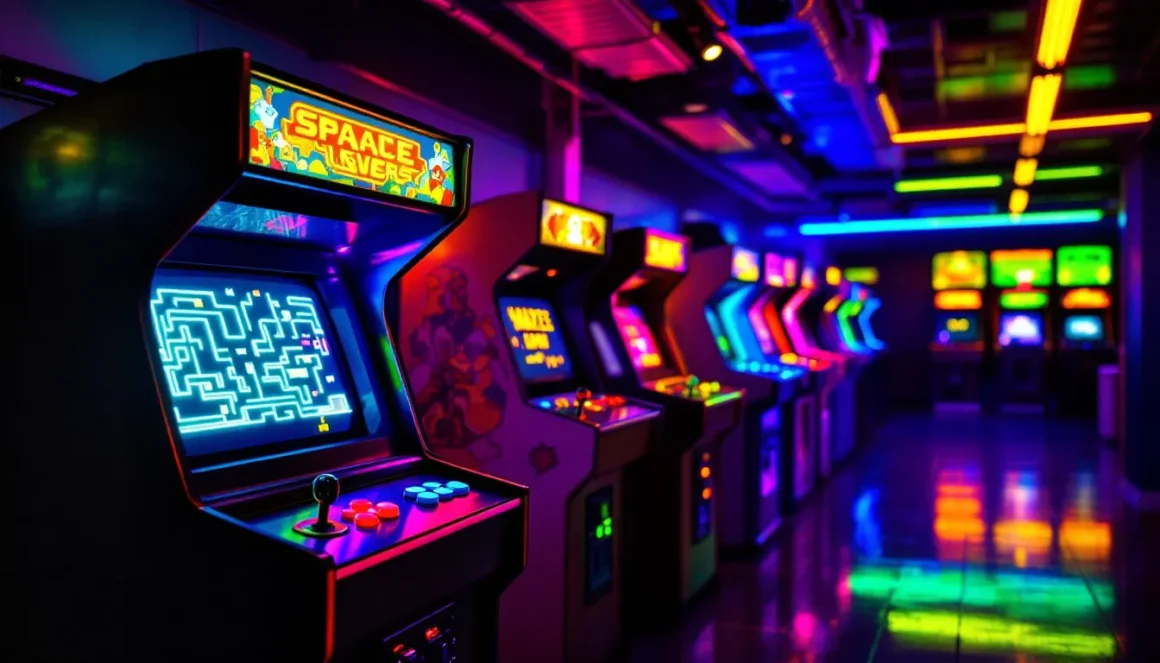
The smell of popcorn mixed with the electric hum of CRT monitors. The clatter of quarters on glass. The satisfying click of joysticks and the mashing of chunky buttons. If you grew up in the 1980s or ever stepped into a classic arcade, these sensory memories hit differently than anything modern gaming offers. This was the decade when gaming exploded from niche hobby to cultural juggernaut, when arcades weren’t just places to play, they were social hubs, battlegrounds for high score supremacy, and the birthplace of franchises that still dominate the industry today.
The 1980s arcade scene wasn’t just about entertainment: it was a technological and cultural revolution. Developers pushed hardware to its limits with every release, creating gameplay mechanics and design philosophies that modern titles still borrow from. From the maze-chasing frenzy of Pac-Man to the quarter-draining difficulty of Dragon’s Lair, these cabinets defined what gaming could be and set the foundation for everything that followed.
Key Takeaways
- 80s arcade games revolutionized the gaming industry by generating $8 billion annually by 1982 and establishing arcades as major cultural institutions where competition and community thrived before the internet.
- Iconic 80s arcade titles like Pac-Man, Donkey Kong, Galaga, and Dragon’s Lair introduced gameplay mechanics, character-driven design, and technological innovations that modern games still adopt today.
- Arcade game design balanced brutal difficulty with fairness, creating addictive high-score systems and quarter-munching business models that directly influenced modern free-to-play and roguelike game mechanics.
- Early arcade hardware evolved dramatically from 8-bit Z80 processors in 1980 to 16-bit systems and dedicated graphics co-processors by decade’s end, creating a technological gap that home consoles couldn’t bridge until the 1990s.
- You can experience authentic 80s arcade games today through MAME emulation, modern retro collections like Arcade1Up cabinets, or digital storefronts like Arcade Archives, preserving gaming history for new generations.
- The legacy of 80s arcade games persists in modern game design through pickup-and-play accessibility, skill-based progression, competitive leaderboards, and pixel art aesthetics that indie developers continue to celebrate and evolve.
Why the 1980s Was the Golden Age of Arcade Gaming
The Birth of Arcade Culture
The late 1970s laid the groundwork, but the 1980s is when arcades truly exploded. What started with Space Invaders (1978) hitting American shores turned into a full-blown phenomenon by 1980 when Pac-Man landed in arcades and became a mainstream obsession. Suddenly, gaming wasn’t just for tech nerds, it was for everyone.
Arcades became the third place between home and school or work. Kids biked across town with pockets full of quarters. Teenagers turned arcade corner spots into their territories, defending high scores like personal honor. The competitive nature of these games created organic leaderboards before the internet existed, and seeing your three-letter initials at the top of a cabinet felt like genuine celebrity status.
This wasn’t just a passing fad. By 1982, the arcade industry was generating $8 billion annually in the US alone, more than pop music and Hollywood combined. The arcade became a legitimate cultural institution, referenced in movies, TV shows, and music throughout the decade.
Technological Breakthroughs That Defined the Decade
The tech leap between 1980 and 1989 was staggering. Early decade cabinets ran on simple 8-bit processors with limited color palettes and primitive sound chips. By decade’s end, games featured detailed sprites, parallax scrolling, digitized voices, and even laserdisc-quality animation.
Hardware evolution came fast:
- 1980-1982: Z80 and 6502 processors powered most cabinets, with games like Pac-Man running at roughly 3 MHz
- 1983-1985: The introduction of 16-bit processors and improved graphics chips enabled richer visuals in games like Marble Madness (1984)
- 1987-1989: Dedicated graphics co-processors and sound chips created arcade experiences impossible to replicate at home, like OutRun (1986) and After Burner (1987)
The business model drove innovation. Arcade operators needed new cabinets to keep players feeding quarters, so manufacturers had to constantly push boundaries. Home consoles couldn’t compete until well into the 1990s, the gap between arcade and home gaming was a genuine technological chasm.
Most Iconic 80s Arcade Games That Shaped Gaming History
Pac-Man: The Cultural Phenomenon
Released by Namco in 1980, Pac-Man wasn’t just a game, it was a cultural explosion. Designer Toru Iwatani wanted to create something that appealed to everyone, not just the space-shooter crowd. The result was a non-violent maze game starring a yellow circle that ate dots and ran from ghosts.
The numbers tell the story. Pac-Man generated over $1 billion in quarters within its first year. It spawned merchandise, an animated TV series, a hit song, and became the first video game character with mainstream name recognition. The game’s pattern-based AI created a skill ceiling that kept hardcore players engaged while remaining accessible enough for anyone to pick up.
Each ghost had distinct behavior algorithms, Blinky chased directly, Pinky tried to ambush, Inky used conditional logic, and Clyde acted erratically. This created emergent gameplay depth that players are still mapping out today. The infamous “split-screen” kill screen at level 256 became legendary, reached by only a handful of players in the early 80s.
Donkey Kong: Where Mario Was Born
Nintendo’s 1981 breakout hit Donkey Kong did more than establish the platform genre, it introduced the world to Mario (originally “Jumpman”). Designer Shigeru Miyamoto created a three-character narrative: the hero, the damsel (Pauline), and the villain (the titular ape).
The gameplay innovation was significant. Unlike static single-screen shooters, Donkey Kong featured four distinct stages with different objectives and mechanics. Players had to master jumping, climbing, dodging barrels, and timing, skills that became platformer fundamentals. The game’s difficulty curve was ruthless but fair, a design philosophy Nintendo carried forward.
Donkey Kong’s impact extended beyond gameplay. It established Nintendo as a major arcade force and laid groundwork for the Super Mario franchise that would define gaming for decades. The game’s success also highlighted the importance of character-driven design over abstract concepts.
Street Fighter II: The Fighting Game Revolution
While Street Fighter (1987) introduced the genre, Street Fighter II (1991, technically early 90s but rooted in 80s development) perfected it and deserves mention for how it built on the decade’s innovations. But, sticking strictly to the 80s, we need to recognize games like Karate Champ (1984) and Yie Ar Kung-Fu (1985) as the true pioneers.
These early fighters established core mechanics: special moves, health bars, round-based combat, and competitive versus modes. They were clunky by modern standards but created the template. The 1980s arcade fighting scene was about reading opponents, memorizing move properties, and mastering timing, skills that transferred directly to the fighting game explosion of the 90s.
Galaga and Space Invaders: The Shoot ‘Em Up Legends
Space Invaders (1978) started it, but Galaga (1981) perfected the formula. Namco’s sequel to Galaxian added the risk-reward mechanic of letting enemies capture your ship, then rescuing it for dual-firepower. This single decision added strategic depth that kept players coming back.
Galaga’s challenge stages, where enemies flew in formation without firing, became a skill showcase. Clearing them perfectly was a badge of honor. The game’s difficulty scaling was precise: it got harder without feeling cheap, unlike many quarter-munchers of the era that relied on artificial difficulty spikes.
Both titles established the shoot ’em up as arcade royalty. The genre dominated cabinets throughout the 80s with variations like Defender (1981), Robotron: 2084 (1982), and R-Type (1987) pushing the formula in new directions.
Dragon’s Lair: The Animated Adventure That Pushed Boundaries
Don Bluth’s Dragon’s Lair (1983) was unlike anything else in arcades. Using laserdisc technology to play full-frame animation, it looked like a playable Disney movie. Players controlled Dirk the Daring through quick-time events, precisely timed inputs that determined whether the hero survived or died in spectacular animated fashion.
The game cost 50 cents per play (double the standard quarter), and lines formed around machines wherever it appeared. That said, Dragon’s Lair was controversial. Many players complained it wasn’t really a “game” but an expensive trial-and-error memorization exercise. You couldn’t strategize or develop skills, just memorize the correct input sequence.
Still, Dragon’s Lair proved arcades could deliver experiences impossible at home. The gap between laserdisc quality and home console graphics was astronomical in 1983. It influenced cinematic gaming approaches and showed what advanced hardware could achieve when developers thought outside conventional design.
Game Mechanics and Design Innovations of the 80s
High Score Systems and Competitive Gaming
The high score table was the original leaderboard, and it drove competitive gaming before the term existed. Seeing “AAA” or someone’s initials at the top created immediate rivalry. Players would spend hours, sometimes entire days, trying to dethrone the local champion.
This system created natural game design pressures. Developers had to balance accessibility (to get casual quarters) with skill ceilings (to keep hardcore players engaged). Games like Defender and Tempest (1981) had effectively infinite progression, allowing skilled players to loop levels until physical exhaustion or machine errors ended their run.
The early 1980s saw the rise of competitive gaming pioneers. Twin Galaxies, founded by Walter Day in 1981, began tracking world records officially. Life Magazine’s 1982 feature on arcade champions like Billy Mitchell legitimized competitive gaming as a serious pursuit. These weren’t just kids playing games, they were athletes mastering complex systems.
The Quarter-Munching Business Model
Let’s be honest: many 80s arcade games were designed to kill you. The business model demanded it. Operators split revenue with distributors, and cabinet placement in prime locations meant games needed to generate serious cash. A game that let players play for an hour on one quarter would be pulled from the floor.
This created design philosophies we’d call predatory today. Difficulty spikes, unavoidable damage, and RNG-based cheap deaths were features, not bugs. Games like Ghosts ‘n Goblins (1985) were legendarily unfair, and players loved them anyway because the challenge felt earned when you finally progressed.
That said, the best designers balanced difficulty with fairness. Games like Bubble Bobble (1986) and Contra (1987) were hard but never felt cheap. Every death was a learning opportunity. This design philosophy, punishing but fair, influenced countless modern titles, from Dark Souls to roguelikes.
How 80s Arcade Cabinets Were Designed
Art, Graphics, and Visual Style
Arcade cabinet art in the 80s was essential marketing. The side panels, marquees, and bezel artwork sold the fantasy before players inserted a quarter. Artists created elaborate painted scenes that the in-game graphics couldn’t match, the cabinet art for games like Zaxxon (1982) or Dragon’s Lair showed detailed scenes while actual gameplay was far more abstract.
In-game graphics evolved dramatically. Early 80s titles used simple sprites and limited color palettes, Pac-Man used just 16 colors total. By mid-decade, games like Paperboy (1985) featured detailed isometric graphics. Late 80s cabinets pushed sprite counts and parallax scrolling, creating depth and visual richness previously impossible.
Pixel art became an art form by necessity. Limited resolution meant every pixel mattered. Character designers became masters of suggestion, a few well-placed pixels created recognizable characters like Mega Man or Ryu. This aesthetic, born from hardware limitations, became a beloved style that persists in indie games today. If you’re curious about how different cabinet styles evolved, modern enthusiasts collect various arcade formats.
Sound Design and Memorable 8-Bit Soundtracks
Audio in 80s arcades had to cut through the noise, literally. Designers created distinctive sounds that grabbed attention from across the room. The Pac-Man wakka-wakka, the Donkey Kong jump sound, the Q*bert nonsensical speech, these became cultural touchstones.
Early sound chips were primitive. The General Instrument AY-3-8910 and similar chips could produce maybe three voices simultaneously. Composers worked within brutal constraints, creating memorable melodies from simple waveforms. The Galaga theme, Frogger’s highway crossing music, and Donkey Kong’s level start jingle are still instantly recognizable 40+ years later.
By the late 80s, sound hardware improved dramatically. Games like OutRun (1986) featured full background music with multiple channels. Double Dragon (1987) had surprisingly robust soundtracks considering the hardware. Some cabinets even included FM synthesis chips, allowing more complex audio that approached home computer quality. The culture that developed around these arcades, from competitive play to collecting experiences, continues to influence modern gaming venues.
The Arcade Experience: Social Gaming Before the Internet
Arcades were social spaces in ways online gaming can’t replicate. You stood next to someone, watched them play, learned their strategies, challenged them directly. The physical presence created stakes. Losing to someone standing right there, watching your failure, hit different than losing to “xXSniperKing420Xx” online.
Competition manifested in interesting ways. Some arcades maintained notebooks where players logged tips and strategies. Others had unspoken rules about quarter placement, putting your quarter on the cabinet reserved your next turn. Breaking these social contracts could start genuine conflicts.
But cooperation existed too. Watching a skilled player tackle a game you struggled with was educational. Veterans would sometimes coach newcomers, explaining patterns or strategies. Co-op cabinets like Gauntlet (1985) or Rampage (1986) created shared experiences, with players coordinating strategies and celebrating victories together.
The arcade was also a great equalizer. Nobody cared about your background, only your skill mattered. The kid who aced every level of Tempest earned respect regardless of age, race, or social status. The culture had problems (it was predominantly male-dominated), but at its best, arcades created meritocracies where execution was everything. For those who want to recapture that feeling today, there are ways to recreate the authentic arcade experience.
How to Play 80s Arcade Games Today
Emulation and MAME: Preserving Arcade History
MAME (Multiple Arcade Machine Emulator), first released in 1997, remains the gold standard for playing authentic arcade games on modern hardware. The project has documented and emulated thousands of arcade boards, preserving gaming history that would otherwise be lost to hardware degradation and failed components.
Running MAME is straightforward. Download the emulator, acquire ROM files (legal gray area, technically, you should own the original cabinet), and map your controls. Modern versions support shaders that simulate CRT scanlines and phosphor glow, recreating the authentic visual experience.
Performance isn’t an issue on any modern PC. Even demanding late-80s games like After Burner or Hard Drivin’ run flawlessly on basic hardware. The challenge is controls, keyboard and standard gamepads don’t replicate arcade stick and button responsiveness. Enthusiasts build custom fight sticks or full control panels with authentic Sanwa or Happ components for the genuine feel.
Modern Arcade Cabinets and Retro Collections
The retro arcade market has exploded recently. Companies like Arcade1Up produce 3/4-scale replicas of classic cabinets at reasonable prices ($300-600). These aren’t perfect, the smaller size and LCD screens differ from originals, but they’re attractive, officially licensed, and work well for home setups.
For authenticity, original cabinets still circulate through collector markets. Prices vary wildly. Common titles like Ms. Pac-Man or Galaga might run $500-1500 in working condition. Rare or pristine examples can hit five figures. Restoration is its own hobby, replacing CRT monitors, repairing power supplies, fixing boardset issues, and restoring cabinet artwork.
Some enthusiasts build MAME cabinets using original arcade hardware shells. These custom builds run modern PCs inside vintage cabinets, combining authentic control feel with the full MAME library. It’s the best of both worlds if you have space, budget, and technical skills. Those interested in the broader history of arcade collecting can explore how arcade venues evolved.
Online Platforms and Remastered Versions
Digital storefronts offer surprising amounts of classic arcade content. Arcade Archives by Hamster Corporation releases authentic arcade games on PlayStation and Switch, complete with original difficulty settings and screen orientations. These releases include modern conveniences like save states while preserving the core experience.
Antstream Arcade offers a streaming service dedicated to retro games, including hundreds of arcade titles. It runs on cloud servers, so no downloads needed, though input lag can be noticeable on faster games. The service includes online leaderboards and tournaments, recreating the competitive aspect of original arcades.
Many classic franchises have received compilation releases. Capcom Arcade Stadium, SNK 40th Anniversary Collection, and Atari Flashback Classics bundle dozens of arcade titles with quality-of-life features. These collections vary in emulation quality, but they’re legal, affordable, and convenient.
For those seeking authenticity, nothing beats MAME or original hardware. But for casual players wanting to sample history without technical hassles, modern digital releases work fine. Racing fans in particular can trace how the genre developed through arcade driving evolution.
The Lasting Legacy of 80s Arcade Games on Modern Gaming
Walk through modern game design and you’ll find 80s arcade DNA everywhere. The instant-action pickup-and-play philosophy? Arcade games. The emphasis on high scores and leaderboards? Arcade games. The concept of “one more try” that hooks players into extended sessions? Absolutely arcade games.
Specific mechanics trace directly to 80s arcades. The combo system in modern fighters evolved from arcade design. The twin-stick shooter formula used in games like Geometry Wars or Enter the Gungeon comes straight from Robotron: 2084. The pattern recognition and timing required in bullet hell shooters like Touhou descends from 80s shoot ’em ups.
The business model evolved but persists. Free-to-play mobile games use the same psychological hooks arcades pioneered, short play sessions, incremental progression, and monetization through continued engagement. The quarter has been replaced by microtransactions, but the core loop remains similar.
Modern indie developers embrace arcade design openly. Games like Downwell, Cuphead, and Celeste use arcade-style difficulty curves and instant restarts. Roguelikes borrow heavily from arcade philosophy, procedural generation combined with skill-based progression and permadeath. The speedrunning community applies arcade-era optimization and execution to modern games.
Even visual aesthetics persist. Pixel art, once a hardware limitation, became a deliberate artistic choice. Developers use retro visuals to evoke nostalgia and demonstrate that strong design transcends graphical fidelity. The respect for 80s design extends beyond imitation, it’s genuine admiration for the creativity developers achieved within brutal constraints. The broader trend of retro gaming returning to prominence shows how these classics continue influencing the industry.
Conclusion
The 80s arcade era wasn’t just about the games, though they were legendary. It was about the experience, the culture, and the technological leaps that redefined what gaming could be. Those cabinets, with their glowing screens and physical controls, established design principles and competitive frameworks that still shape the industry decades later.
Today’s gaming landscape, with its online leaderboards, competitive scenes, and emphasis on skill-based progression, owes an enormous debt to those quarter-fed machines. The franchises born in 80s arcades, Mario, Street Fighter, Pac-Man, remain industry pillars. The mechanics pioneered back then appear in virtually every modern genre.
Whether you’re diving into MAME, hunting for original cabinets, or just appreciating where gaming came from, the 80s arcade era deserves recognition as more than nostalgia. It was the foundation. The template. The golden age that proved gaming wasn’t a fad but the beginning of a medium that would define entertainment for generations.