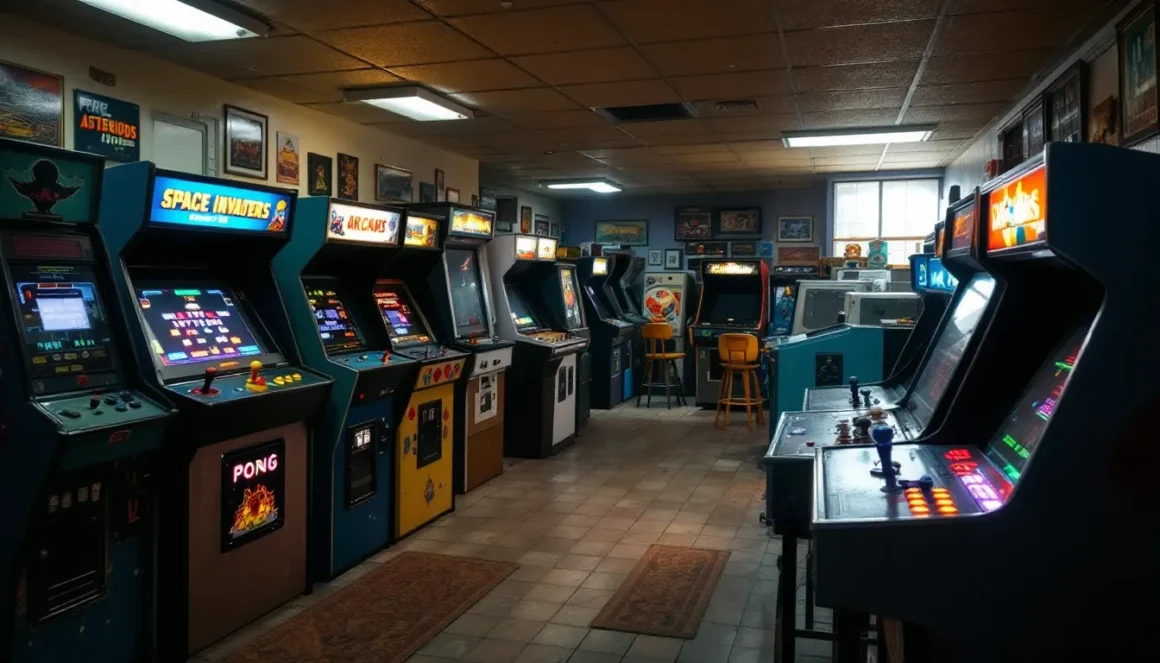
Walk into any modern arcade bar and you’ll see it, grown adults dumping tokens into machines older than they are, chasing high scores on pixel-perfect recreations of games that defined an entire industry. The 1970s weren’t just another decade for gaming. They were the decade where gaming became a cultural force, transforming from university computer labs and engineering curiosities into packed arcades that ate millions of quarters and changed entertainment forever.
Before battle royales, before DPS meters, before frame-rate debates, there was a simpler promise: drop a quarter, prove your skill, and maybe, just maybe, get your initials on the high score board. The 1970s video games era birthed genres that still dominate today, established design principles that modern developers reference constantly, and created a social gaming culture that esports is only now rediscovering. This wasn’t just the birth of arcade gaming, it was the blueprint for everything that followed.
Key Takeaways
- 1970s arcade games transformed from technical curiosities into a cultural force that established design principles still referenced by modern developers today.
- Pong’s genius lay not in technical innovation but in instant playability—a simple two-paddle, one-ball concept that anyone could understand in seconds, making it the blueprint for arcade success.
- Space Invaders revolutionized arcade gaming with escalating difficulty, destructible cover, and a high-score culture that drove a global boom, generating over $2 billion in revenue by 1982.
- Early arcade hardware constraints forced creative solutions that became genre-defining mechanics, from Asteroids’ vector graphics physics to Breakout’s risk-reward brick-breaking design.
- The quarter-based business model and social arcade culture created organic competition and community engagement that became the foundation for modern esports and competitive gaming.
- 1970s arcade games stripped away narrative and progression systems to focus purely on skill execution and score optimization—a design philosophy that directly influences today’s roguelikes and indie games.
The Birth of the Arcade Era
How Computer Space Sparked the Revolution
Nolan Bushnell and Ted Dabney didn’t invent video games when they released Computer Space in 1971, but they did something arguably more important, they made the first commercially available arcade video game. Based on the 1962 MIT game Spacewar., Computer Space asked players to pilot a rocket ship against flying saucers using a control scheme that, frankly, confused the hell out of most bar patrons.
The game flopped commercially. Only 1,300-1,500 units shipped, and Bushnell later admitted the game was too complicated for drunk people to figure out. But the failure taught a crucial lesson: arcade games needed to be instantly understandable. You had seconds to hook a player, not minutes. That insight would shape every successful arcade game that followed.
Even though its commercial failure, Computer Space proved the concept worked. Bars and entertainment venues would pay for machines. Players would pump in coins. The business model was viable, the execution just needed refinement.
The Technology Behind Early Arcade Cabinets
Early 1970s arcade hardware was brutally simple by modern standards. Discrete logic circuits, hardwired transistors, capacitors, and resistors, handled all game logic. There were no microprocessors, no CPUs in the traditional sense. Each game’s circuit board was physically designed to play that specific game and nothing else.
The displays used black-and-white monitors, often with colored plastic overlays taped to the screen to simulate color graphics. Sound? Equally primitive, analog circuits generating basic tones and bleeps. The iconic “pew pew” sounds weren’t sampled audio files: they were voltage patterns fed through speakers.
Everything changed mid-decade when affordable microprocessors hit the market. The Intel 8080 and later chips allowed programmers to code game logic in software rather than soldering it in hardware. This shift exploded creativity and slashed development costs. By 1978, arcade cabinets were running increasingly complex code, setting the stage for the genre diversity that would define the decade’s end.
Pong: The Game That Made Arcades Mainstream
Why Pong Became a Cultural Phenomenon
Bushnell’s next attempt after Computer Space was Pong (1972), and this time Atari nailed it. Two paddles. One ball. First to 11 points wins. A drunk toddler could understand it in five seconds, which was exactly the point.
The prototype installed at Andy Capp’s Tavern in Sunnyvale broke within two weeks, not from mechanical failure, but because the coin box was literally overflowing. Players lined up, fed quarters relentlessly, and turned Pong into a phenomenon before Atari could even manufacture units at scale. By 1974, Pong had spawned countless clones and knockoffs, flooding bars, bowling alleys, and pizza joints across America.
Pong’s genius wasn’t technical innovation, table tennis video games existed before it. The magic was in the execution: smooth paddle control, satisfying ball physics with subtle speed increases, and that perfect risk-reward loop. Competitive players developed actual technique, discovering that paddle positioning affected ball angle. Meta strats emerged for a game with two buttons and a knob.
The Rise of Atari and the Home Console Connection
Pong’s arcade success funded Atari’s next gambit, bringing games home. The Home Pong console, released through Sears in 1975, moved 150,000 units in its first year. It was a calculated pivot: arcade quarters would always flow, but owning the home market meant recurring revenue without location deals or maintenance.
This dual-market strategy defined Atari’s 1970s dominance. Arcade hits would prove concepts and build hype: home versions monetized that recognition. The modern racing game evolution traces directly back to this playbook, prove it in arcades, scale it to homes.
Atari’s competitors noticed. By 1976, dozens of companies were chasing both arcade and home markets, each trying to replicate Pong’s simple-yet-addictive formula. The race was on, and Japan was paying very close attention.
Space Invaders and the Japanese Invasion
Revolutionary Gameplay Mechanics
Tomohiro Nishikado’s Space Invaders (1978) wasn’t just another shooter, it was a complete rethink of what arcade games could be. Taito’s release introduced mechanics that seem obvious now but were revolutionary then: enemies that fired back, destructible cover, escalating difficulty as enemies moved faster when their numbers thinned, and most critically, the concept of progressive waves.
The game’s technical achievement was equally impressive. Nishikado designed custom hardware when existing chips couldn’t handle his vision, essentially creating a bespoke system for the alien invasion concept. The iconic descending “DUM-dum-DUM-dum” soundtrack wasn’t just atmosphere, it was a brilliant psychological trick. The tempo increased as aliens approached, naturally ramping player tension without a single line of dialogue or tutorial.
Space Invaders introduced the high score table that dominated arcade culture for decades. Your three initials preserved forever (or until someone unplugged the machine) became the ultimate flex. Players developed specific strategies for maximizing points, learning the exact timing to hit the mystery UFO for maximum value, recognizing optimal cover usage patterns, and discovering the rhythm of the alien march.
The Global Impact and Arcade Boom
Space Invaders didn’t just succeed, it detonated. Japan experienced a documented 100-yen coin shortage in 1978, partially attributed to the game’s ravenous appetite for currency. By 1982, the game had grossed over $2 billion in quarters (roughly $6.2 billion in 2026 dollars). According to Game Rant’s historical analysis, Space Invaders became the first arcade game to achieve true global cultural penetration.
The game’s success triggered an explosion in arcade construction. Shopping malls, airports, grocery stores, anywhere with foot traffic suddenly wanted cabinets. Dedicated arcades expanded from small operations to massive venues housing dozens of machines. The quarter-munching business model printed money, and everyone wanted in.
Japanese developers, inspired by Space Invaders’ success, began flooding the market with increasingly sophisticated games. The Western-dominated arcade industry suddenly faced fierce competition from companies like Namco, Konami, and Capcom. The best ideas won, regardless of origin.
Breakout, Asteroids, and Vector Graphics Innovation
How Breakout Evolved the Paddle Game Formula
Atari’s Breakout (1976) took the paddle concept from Pong and transformed it into a single-player puzzle-action hybrid. Designed by Nolan Bushnell and Steve Bristow, with significant circuit board work by Steve Wozniak and Steve Jobs, Breakout challenged players to demolish a wall of bricks using a ball and paddle.
The genius was in the risk-reward balance. Breaking through to the top layers meant the ball would ricochet wildly in the brick-filled space, clearing blocks fast but making control nearly impossible. Conservative play kept the ball manageable but burned precious time. Skilled players learned to thread specific angles, creating controlled chaos that maximized efficiency.
Breakout’s minimalist design influenced decades of games. The “destroy all blocks” objective spawned an entire genre that persists today in mobile puzzle games and indie releases. The core loop, aim, break, repeat, proved endlessly remixable, spawning countless variations throughout the late ’70s.
Asteroids and the Vector Graphics Revolution
Atari’s Asteroids (1979) represented a complete departure from raster graphics. Using vector displays that drew lines directly with electron beams rather than illuminating pixels, Asteroids achieved crisp, scaling graphics impossible on standard monitors. The result was a visually distinctive game where asteroid chunks shattered convincingly and your tiny ship rotated with geometric precision.
Gameplay mechanics were equally innovative. The thrust-based physics required players to master momentum and inertia in a wraparound playfield. Button inputs were simple, rotate left, rotate right, thrust, fire, hyperspace, but mastery demanded understanding Newtonian motion. Optimal play meant constantly drifting, using minimal thrust to conserve control while lining up shots on tumbling asteroids.
Asteroids became Atari’s best-selling arcade game, moving over 70,000 cabinets. The vector display’s sharp lines and smooth scaling created an aesthetic that raster games couldn’t match until significantly more powerful hardware arrived. Players hunting hidden arcade classics consistently cite Asteroids as the vector era’s defining experience.
The game’s high skill ceiling attracted competitive players who developed advanced techniques, learning safe positions on the screen, optimal asteroid break patterns, and UFO manipulation tactics. The hyperspace button, seemingly a panic escape, became a calculated risk in expert play, used to reposition rather than simply survive.
The Evolution of Arcade Game Genres in the 1970s
Maze Chase Games and Early AI Enemies
While Pac-Man’s 1980 release technically falls outside our timeframe, the maze chase foundation was laid in the late ’70s. Games like Gotcha (1973) and Pursuit (1975) experimented with confined playfields where players navigated corridors while being chased by AI opponents.
The AI wasn’t particularly intelligent, most games used simple patrol patterns or basic “move toward player” logic. But the psychological impact was real. Being hunted created tension that static targets couldn’t match. These early experiments established patterns that different arcade game types would refine throughout the ’80s.
The technical challenge of pathfinding in limited hardware pushed developers to create clever illusions. Enemies didn’t need sophisticated AI if level design funneled players into tense encounters naturally. Tight corridors, blind corners, and chokepoints did the heavy lifting.
Racing Games and Driving Simulators
Atari’s Gran Trak 10 (1974) introduced the racing genre with an actual steering wheel, four-position gear shifter, and accelerator/brake pedals. The raster graphics displayed a top-down view of a scrolling track, challenging players to complete laps before time expired.
Technology severely limited these early racers. Tracks couldn’t be too complex due to memory constraints, and opponent AI was nearly nonexistent, most games featured solo time trials. But the physical controls created immersion that joysticks couldn’t match. Yanking the wheel, downshifting into a curve, and hammering the accelerator out of a turn engaged players physically.
Sega’s Monaco GP (1979) and Namco’s Pole Position (arriving in 1982) refined the formula, but the ’70s established the blueprint: driving games needed analog controls and demanded reaction time over strategy. The genre’s evolution across decades shows consistent commitment to those core principles.
Fixed Shooter vs. Multi-Directional Shooters
Fixed shooters dominated the late ’70s. Space Invaders and Galaxian (1979) locked players at the screen’s bottom, firing upward at descending enemies. The limited movement created intense focus, all variables reduced to timing and positioning along a single axis.
Multi-directional shooters offered more freedom but required more complex controls. Asteroids’ 360-degree rotation demonstrated the genre’s potential, while games like Space Wars (1977) experimented with dual-stick-style controls using multiple buttons.
The split between these approaches defined shooter design philosophy. Fixed shooters optimized for arcade environments, quick to learn, brutal to master, perfect for high turnover. Multi-directional games attracted dedicated players willing to invest time learning complex controls for deeper gameplay. Both approaches thrived because they served different player types in the same ecosystem.
The Arcade Business Model and Quarter Culture
How Arcades Became Social Hubs
Arcades in the 1970s weren’t just places to play games, they were legitimately the place to be. Before internet cafes, before gaming lounges, arcades served as the primary social space for young people who weren’t interested in traditional sports or structured activities.
The layout encouraged socialization. Machines lined walls, creating natural spectator lanes where crowds gathered behind skilled players. Watching someone clear five waves of Space Invaders was entertainment itself. Players learned by observation, studied techniques, and absorbed strategies before risking their own quarters.
The quarter standard created a universal language. Everyone understood the stakes: $0.25 bought you one life (or a few lives if the operator was generous with dip switch settings). Running out of quarters meant your session ended, creating natural breaks for social interaction. Players would trade tips, argue about high scores, and occasionally challenge each other directly.
High Score Competition and Early Esports Roots
The high score table was more than a leaderboard, it was your legacy. Three initials immortalized skill in a way that modern achievement systems can’t replicate. Everyone in your local scene knew who “ACE” or “MAD” was. Top players achieved genuine local celebrity status.
Competition escalated quickly. Players memorized enemy patterns, discovered exploits, and developed execution skills honed by hundreds of quarters and countless hours. The best players weren’t just good, they were untouchable, pulling off feats that seemed impossible to casual observers.
Tournaments emerged organically. Kotaku’s coverage of retro gaming history notes that while organized esports wouldn’t formalize for decades, local arcade competitions in the late ’70s featured prize pools, spectator crowds, and intense rivalry. Video game champions became cover stories in mainstream media, with players like Billy Mitchell and Steve Juraszek building reputations that persist today.
Owners discovered that top players actually drove business. Watching an expert perform attracted crowds, and those crowds fed quarters into other machines while waiting their turn. The best players received free play or sponsorship deals, primitive team jerseys in the form of venue loyalty.
Most Influential 1970s Arcade Games You Should Know
Must-Play Titles That Defined the Decade
Beyond the big names, several titles shaped arcade gaming’s trajectory:
Lunar Lander (1979) – Atari’s vector-based physics simulator challenged players to land a spacecraft using limited fuel. The game’s realistic thrust mechanics and unforgiving gravity made it brutally difficult but deeply satisfying for players who mastered the controls.
Galaxian (1979) – Namco’s response to Space Invaders added color graphics and kamikaze-diving enemies that broke formation to attack. The dynamic enemy behavior forced players to abandon static strategies and adapt in real-time.
Night Driver (1976) – Atari’s first-person racing game created the illusion of 3D using scrolling posts flanking a road. The perspective shift was revolutionary, influencing every racing game that followed.
Sea Wolf (1976) – Midway’s submarine simulator featured a physical periscope viewer and timed torpedo mechanics. The tactile interface and naval warfare theme demonstrated genre diversity beyond space and sports.
Speed Race (1974) – Taito’s top-down racer introduced vertical scrolling, limited time, and collision detection. The game’s success in Japan validated racing as a viable arcade genre outside Western markets.
Hidden Gems and Forgotten Classics
Some games deserve more recognition than history granted them:
Death Race (1976) – Exidy’s controversial game cast players as drivers running over gremlins (which looked suspiciously like human figures). The moral panic it triggered predated every modern “video games cause violence” debate by decades. Commercially, the controversy actually boosted sales.
Boot Hill (1977) – Midway’s Western-themed shooter featured two-player duels using light guns and western scenery. The competitive multiplayer focus made it a local favorite, though national distribution was limited.
Depthcharge (1977) – Gremlin’s submarine warfare game flipped the Sea Wolf formula, letting players drop depth charges on ascending subs. The simple mechanics masked surprising strategic depth in enemy prioritization.
Gun Fight (1975) – Midway’s licensed version of Taito’s Western Gun was the first arcade game to use a microprocessor, making it historically significant beyond its two-player cowboy duels. The tech breakthrough enabled more complex games throughout the decade’s second half.
Exploring retro arcade formats reveals how these forgotten titles influenced modern indie games and competitive shooters. The DNA persists even when the original names fade from memory.
The Lasting Legacy of 1970s Arcade Games
How These Games Influenced Modern Gaming
Every core mechanic modern gamers take for granted traces back to 1970s arcades. The concept of lives as a difficulty mechanism? Arcade quarter optimization. High score leaderboards dominating competitive games? Direct descendant of three-letter initial tables. Progressive difficulty that ramps as players improve? Space Invaders’ accelerating aliens established the pattern.
Game feel, that intangible quality that separates good games from great ones, received its foundational work in the ’70s. Developers had severely limited tools, so every input needed weight and response. Pong’s paddle control feels right because Atari iterated obsessively on the knob’s resistance and paddle speed. That attention to physical feedback influenced controller design for decades.
Modern roguelikes and score-attack games are spiritually pure 1970s arcade experiences. They strip away narrative, progression systems, and grinding, focusing entirely on skill execution and score optimization. When indie developers chase “just one more run” addiction, they’re channeling the quarter-feeding loop that made arcades print money.
The business model echoes forward too. Free-to-play games asking for microtransactions to continue? That’s the quarter system with extra steps. Battle passes requiring seasonal engagement? The high score chase reformulated for monetization. According to Gematsu’s industry analysis, Japanese developers consistently reference ’70s arcade design when discussing engagement mechanics.
Where to Play 1970s Arcade Games Today
Authentic hardware is increasingly rare, but options exist for experiencing these classics:
Original Cabinets – Dedicated collectors and specialty arcades maintain working machines. Expect to pay premium prices for play or ownership. Fully restored Asteroids and Space Invaders cabinets regularly sell for $2,000-$4,000.
Arcade1Up Cabinets – These ¾-scale reproductions capture the physical cabinet experience at consumer prices ($300-$500). They’re not arcade-perfect, but they nail the form factor and include multiple games per unit.
MAME Emulation – The Multiple Arcade Machine Emulator preserves thousands of games with varying accuracy. Legal gray areas exist around ROM distribution, but the preservation value is undeniable. Pair MAME with quality arcade controls for authentic feel.
Official Collections – Atari, Namco, and other publishers release compilation packages across modern platforms. Atari 50: The Anniversary Celebration (2022) includes extensive historical context alongside playable games.
Arcade Bars and Barcades – These venues combine craft beer with classic cabinets, creating modern social spaces that echo ’70s arcade culture. Most major cities now host multiple locations.
The resurgence of retro arcade interest has improved access significantly. What was niche collecting 15 years ago is now mainstream nostalgia, supported by official releases and thriving communities.
Conclusion
The 1970s arcade era wasn’t just gaming history, it was the foundation that everything else built upon. From Computer Space’s commercial failure that taught crucial design lessons, through Pong’s mainstream breakthrough, to Space Invaders’ global domination, the decade compressed more innovation into ten years than most industries see in fifty.
These weren’t primitive prototypes stumbling toward something better. They were refined, focused experiences that understood their limitations and turned constraints into strengths. Quarter-funded development meant games had to hook players instantly. Limited hardware forced creative solutions that became genre-defining mechanics. Competitive social spaces organically created the community engagement that modern games spend millions trying to engineer.
Walking into an arcade in 1979 meant experiencing the cutting edge of entertainment technology. Walking into one today, or booting up MAME, or dropping by a barcade, means connecting with design principles that still dominate the industry nearly 50 years later. The graphics evolved. The complexity escalated. But the core loop of skill expression, score optimization, and one-more-attempt addiction? That’s pure 1970s arcade DNA, and it’s never going away.